Skip to content

Built in Prince Edward Island · Priced in Canadian dollars · Support from the people who built it

Built in Prince Edward Island · Priced in CAD · PIPEDA-aligned

Run your whole business from one app.
Built for the field and the office.

The schedule, every conversation, the costing and the invoicing in one place — for the people on site and the person at the desk. Priced in Canadian dollars, printed on the page.

No credit card · Your website live on day one · Bring your client list

1 of 3 · A normal week

One job. Everyone talking at once.

The customer texts. The crew sends photos and an update from the site. The office writes back, books the visit and sends the quote. It all happens at the same time, in different places.

2 of 3 · One place

Daybook catches all of it.

Every text, email, photo, note and update from the crew lands on the job it belongs to, as it happens. Nobody forwards anything.

3 of 3 · The brief

And turns it into one brief you can act on.

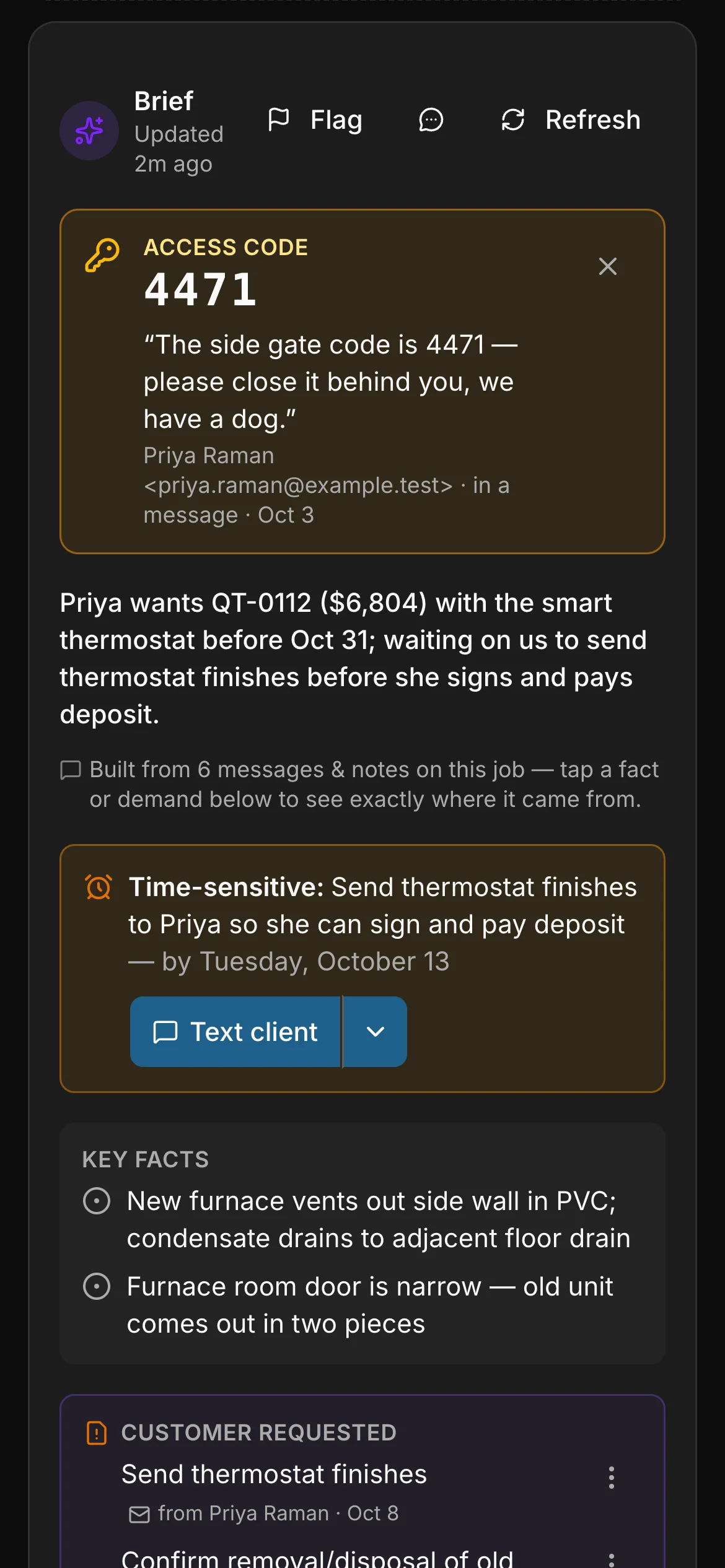
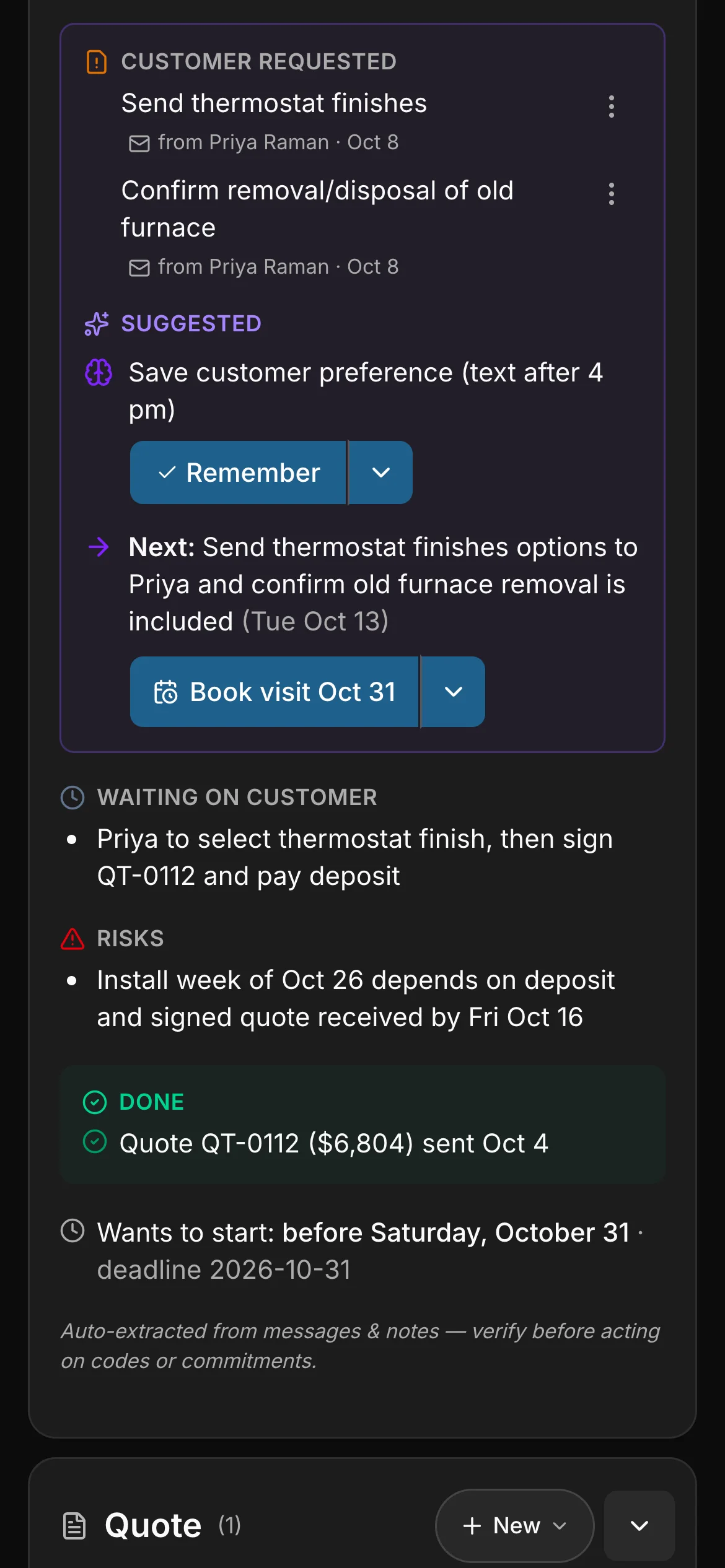
The brief reads what is on the job and tells you where it stands: the gate code, the deadline, what the customer asked for, what you owe them and what they owe you. One tap starts the text, the email, the booking or the reminder. It drafts; you send.

The brief and the Assistant

Texting comes with the top plan of every rate card (Company, for a trade), from a verified toll-free number of your own.

A job in Daybook and its brief: the gate code pinned at the top, a one-line summary, a time-sensitive deadline, key facts, what the customer requested, what is waiting on us with the next step and its date, and what is waiting on the customer.
1The gate code, pinned
2The deadline
3What the customer asked for
4What we owe, and the next step
5What the customer owes

A real capture of a contractor’s job. Daybook wrote every line of this brief from the messages on the job; only the five teal labels are added. A camp gets the same brief on a booking, a property manager on a work order.

1 of 3 · A normal week

One job. Everyone talking at once.

The customer texts. The crew sends photos and an update from the site. The office writes back, books the visit and sends the quote. It all happens at the same time, in different places.

The customerThe customer, textingThe officeA crew memberA crew memberA crew member
  • Our front steps are crumblingThe customer, by email
  • 5 risers. Hand dig on the leftThe crew, from the site
  • Your quote is attachedThe office, by email
  • 3 photosThe crew, from the site
  • Done before the 24th?The customer, by text
  • Gate code 4471. Mind the dogThe office, to the crew
  • Checklist doneThe crew, from the site

2 of 3 · One place

Daybook catches all of it.

Every text, email, photo, note and update from the crew lands on the job it belongs to, as it happens. Nobody forwards anything.

3 of 3 · The brief

And turns it into one brief you can act on.

The brief reads what is on the job and tells you where it stands: the gate code, the deadline, what the customer asked for, what you owe them and what they owe you. One tap starts the text, the email, the booking or the reminder. It drafts; you send.

A job in Daybook and its brief: the gate code pinned at the top, a one-line summary, a time-sensitive deadline, key facts, what the customer requested, what is waiting on us with the next step and its date, and what is waiting on the customer.
1The gate code, pinned
2The deadline
3What the customer asked for
4What we owe, and the next step
5What the customer owes
  1. The gate code, pinned. Said once in an email, and now at the top of the job for the crew.
  2. The deadline. What is time-sensitive, and by when.
  3. What the customer asked for. Each request, with the message it came from.
  4. What we owe, and the next step. One next step, and a button that starts it.
  5. What the customer owes. So nobody chases the wrong person.

A real capture of a contractor’s job. Daybook wrote every line of this brief from the messages on the job; only the five teal labels are added. A camp gets the same brief on a booking, a property manager on a work order.

The brief and the Assistant

Texting comes with the top plan of every rate card (Company, for a trade), from a verified toll-free number of your own.

The Assistant

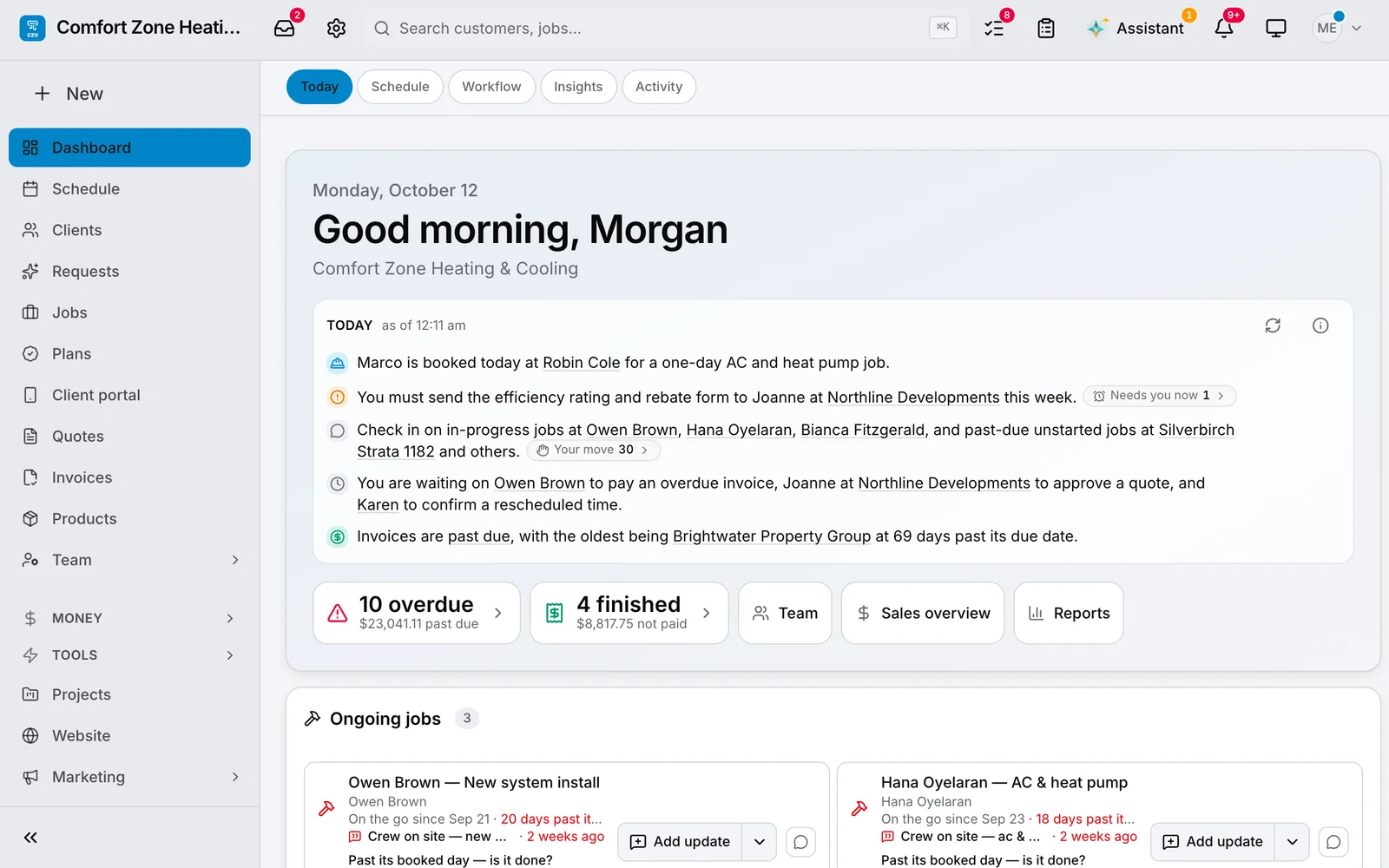
One list of what needs you today.

Who is waiting on you, what is owed, which lead to call back — most pressing first, each with the button that does it. What a brief says you owe a client becomes a line in the list. It opens from any page.

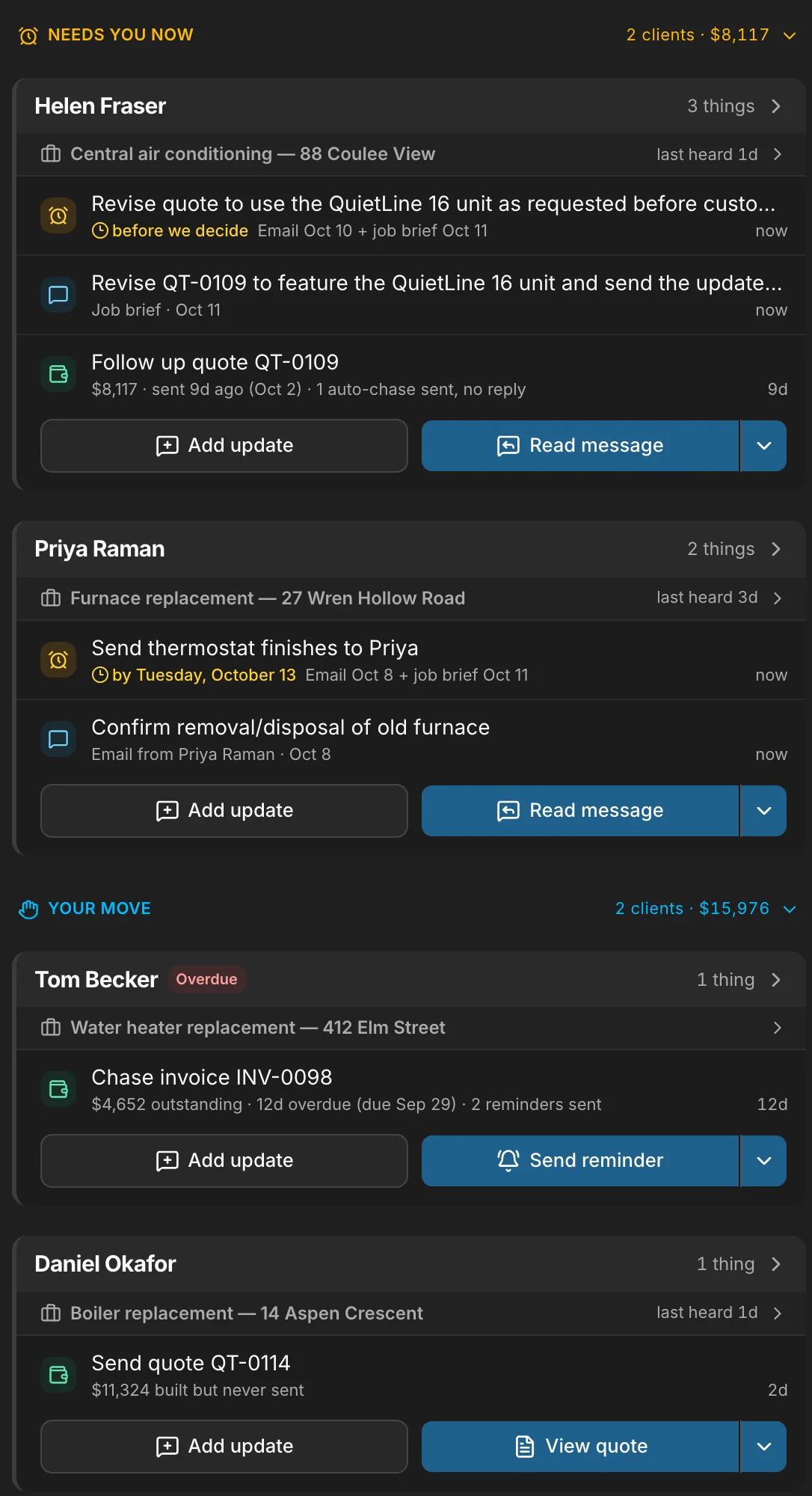
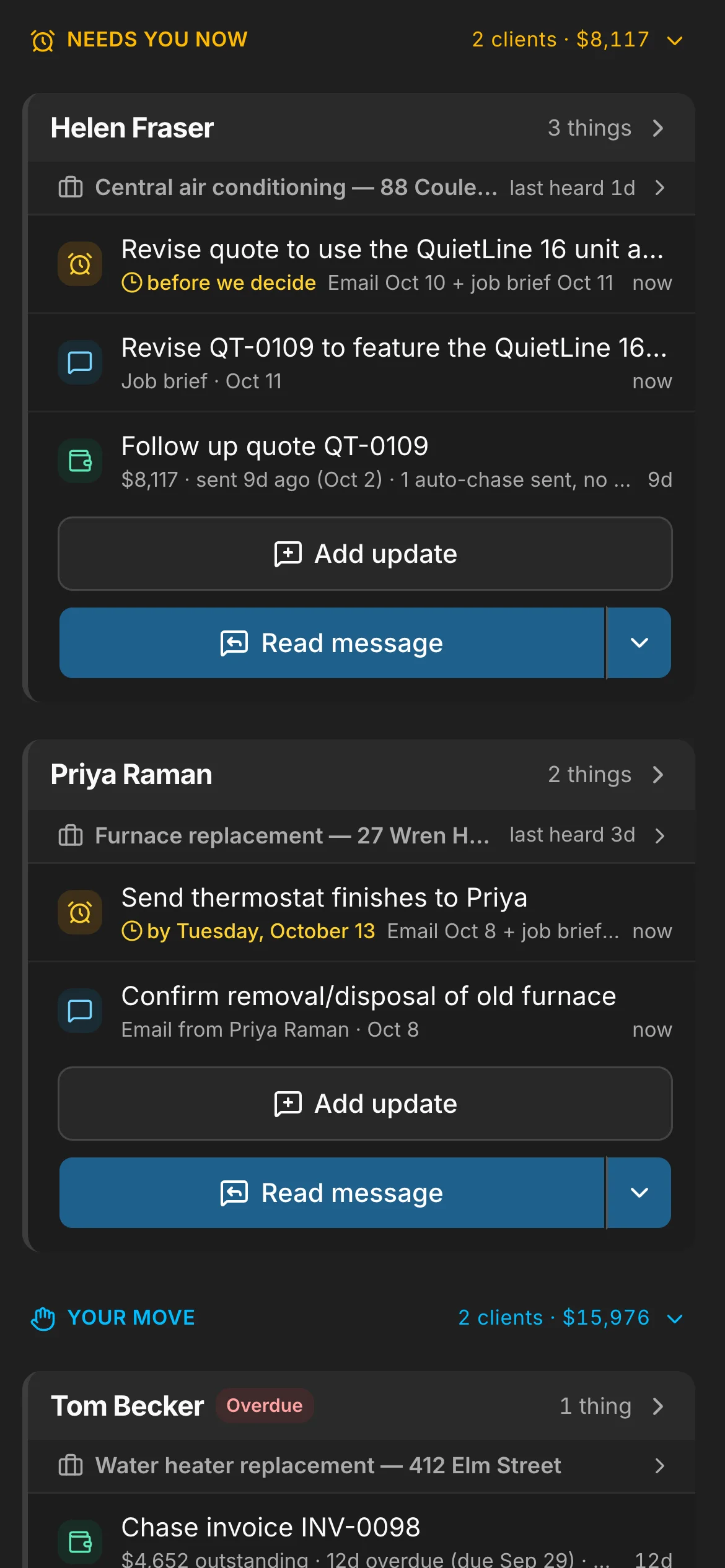
  • The Assistant’s list: “Needs you now” with Priya Raman first and “Your move” with Tom Becker first, one of them an overdue invoice ($5,072 outstanding), each with the button that does it.
    The Assistant’s list: “Needs you now” with Priya Raman first and “Your move” with Tom Becker first, one of them an overdue invoice ($5,072 outstanding), each with the button that does it.

    One list. Who is waiting on you, what is owed and which lead to call back — most pressing first.

  • The Brief card on a job: the access code pinned from the customer’s email, a short summary of where it stands, what is time-sensitive and the key facts.
    Priya Raman · email“The side gate code is 4471 — please close it behind you, we have a dog.”

    The brief. Here on a contractor’s job: the gate code, where it stands and what the client asked for, read from its emails, texts and notes.

    • Draft a reply
    • Send reminder
    • Add task
    • Book visit
    • Text client
    • Remember
    • Add update

    Each one a tap. Draft the reply, send the reminder, add the task, book the visit — from the line it’s on. It never writes to your client by itself. Trades

The Assistant

One list of what needs you today.

Who is waiting on you, what is owed, which lead to call back — most pressing first, each with the button that does it. What a brief says you owe a client becomes a line in the list. It opens from any page.

  • The Assistant’s list: “Needs you now” with Priya Raman first and “Your move” with Tom Becker first, one of them an overdue invoice ($5,072 outstanding), each with the button that does it.

    One list. Who is waiting on you, what is owed and which lead to call back — most pressing first, each with the button that does it.

  • The Brief card on a job: the access code pinned from the customer’s email, a short summary of where it stands, what is time-sensitive and the key facts.

    The brief. Here on a contractor’s job: the gate code, where it stands and what the client asked for, read from its emails, texts and notes.

  • The open work in a brief, with its buttons: what the customer asked for (each with the message it came from), suggested next moves, what is waiting on us and the next step.

    Its next steps, as buttons. What the client asked for, a task to add, the visit to book — each one a tap. It never writes to your client itself. Trades

  • Today: your next five moves, each with the button that does it
  • All: the whole list — client asks, money, leads and scheduling, one card per client
  • Your inbox, chats and client messages in the same panel
  • Opens from any page — the Assistant button, or ⌘/ on a keyboard
The Assistant

Highlights

Small things that give you hours back.

  • The Quote Builder

    Answer what a foreman would ask. It prices the job. Trades

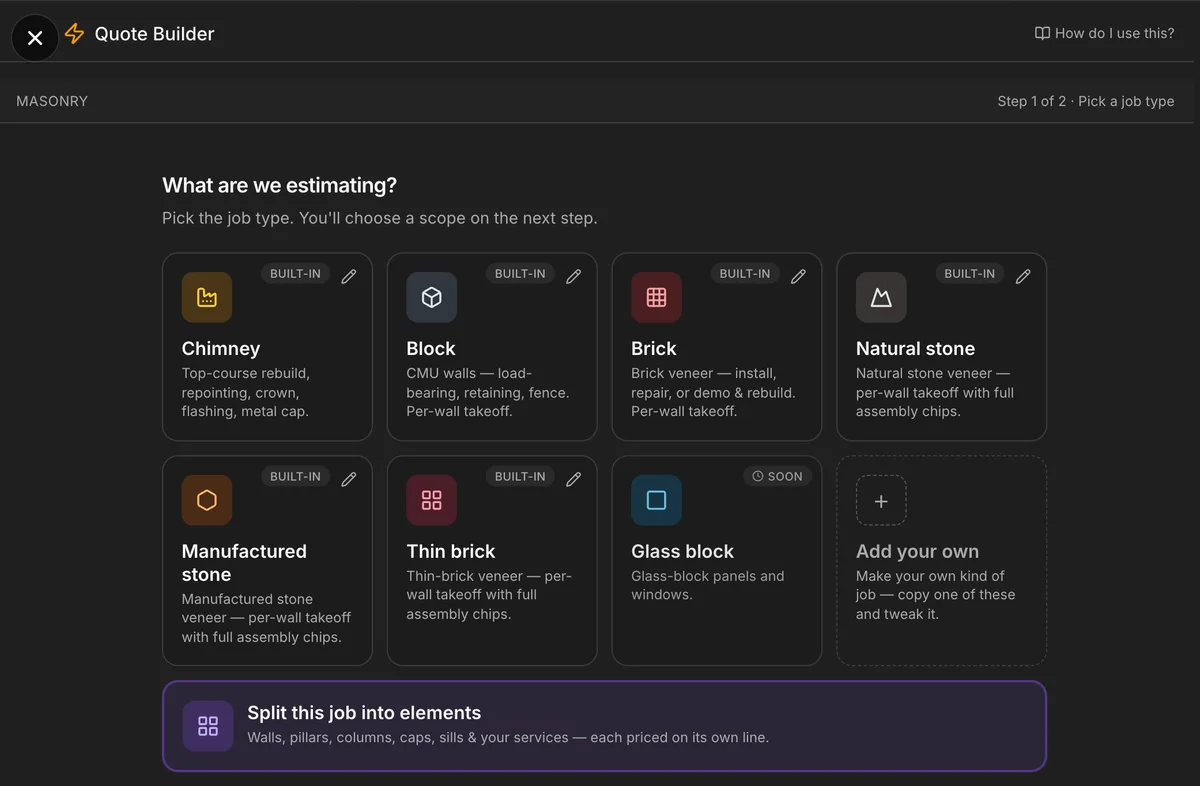
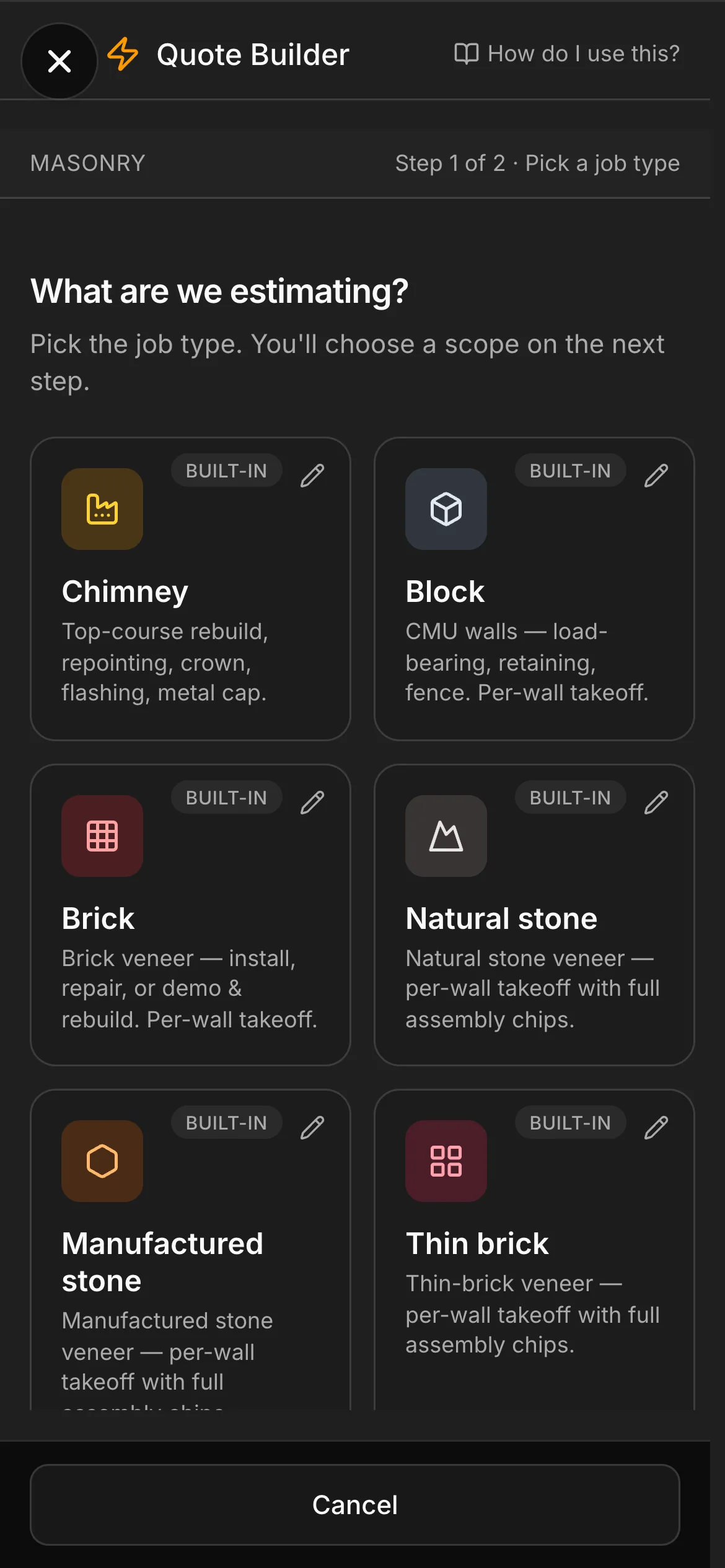
    The Quote Builder asking what the job is: Chimney, Block, Brick, Natural stone, Manufactured stone and Thin brick.
    The Quote Builder asking what the job is: Chimney, Block, Brick, Natural stone, Manufactured stone and Thin brick.
  • Your shop

    Sell it online. Never sell what you don’t have.

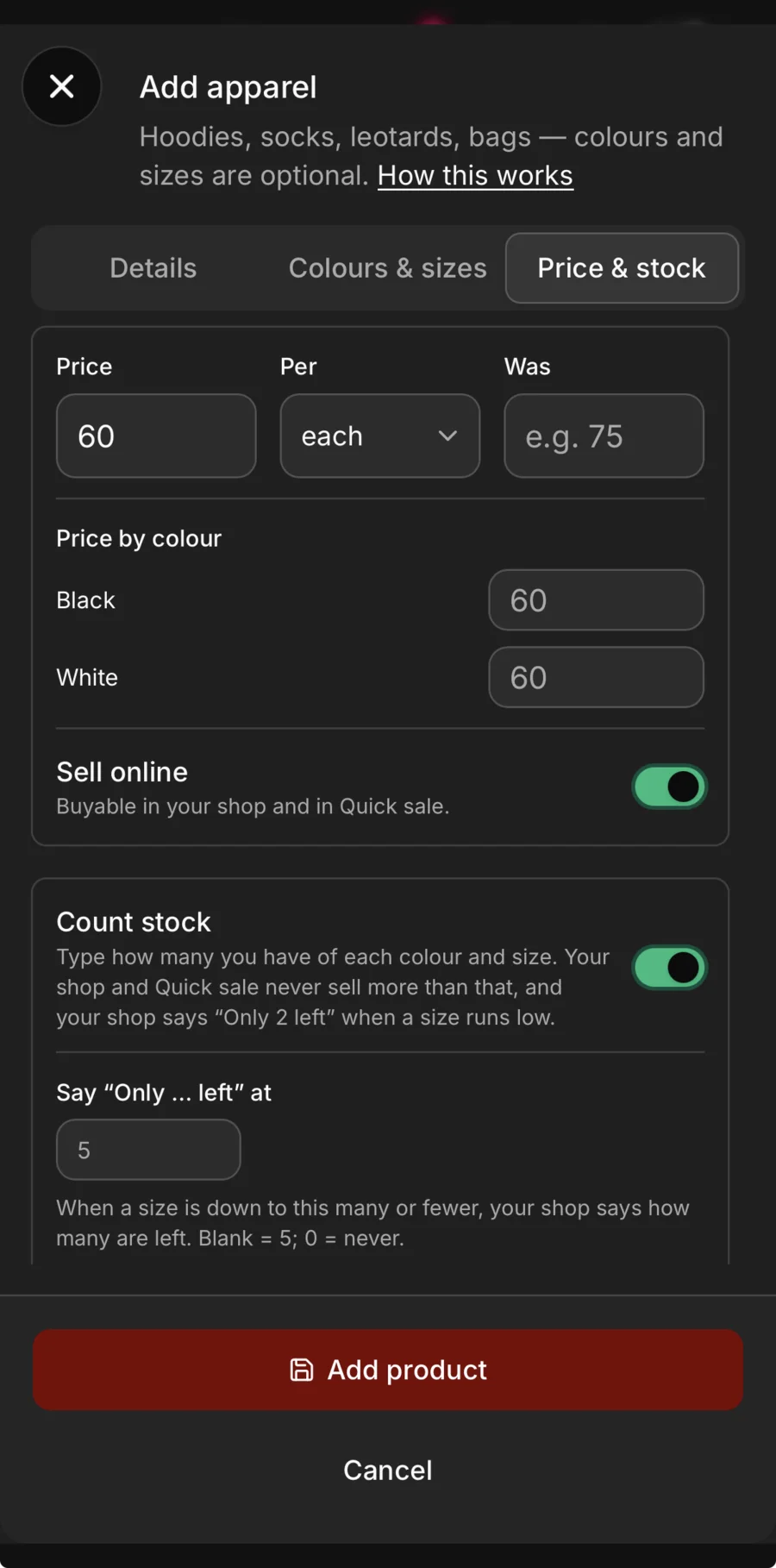
    The hoodie’s Price & stock: 60 each, a price for each colour, Sell online in the shop and in Quick sale, and Count stock, with “Only … left” shown at 5.
  • The +

    One button that knows the page you’re on.

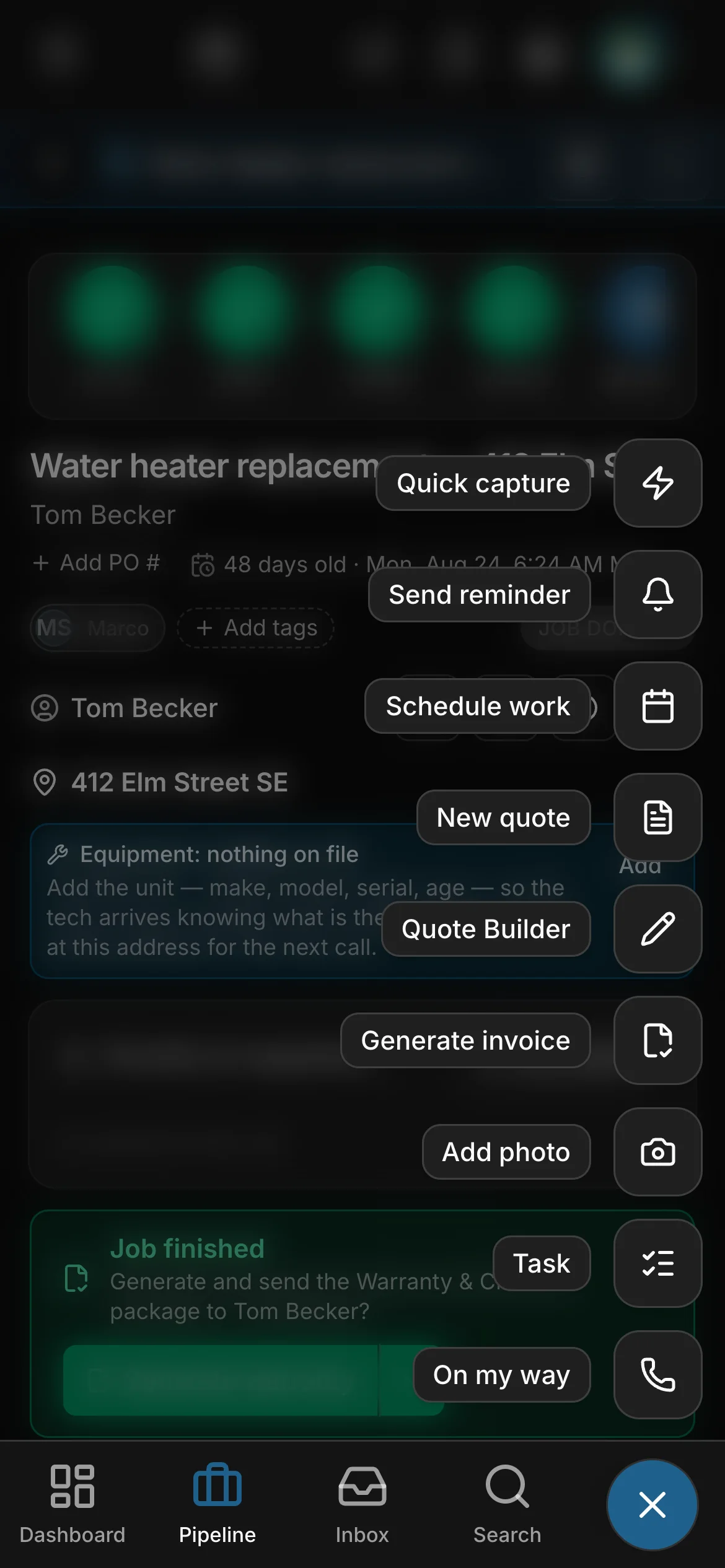
    The create button open on a job’s page: “Quick capture”, “Send reminder”, “Schedule work”, “New quote”, “Quote Builder”, “Generate invoice”, “Add photo”, “Task” and “On my way”.
  • Your website

    Your website, changed from your phone.

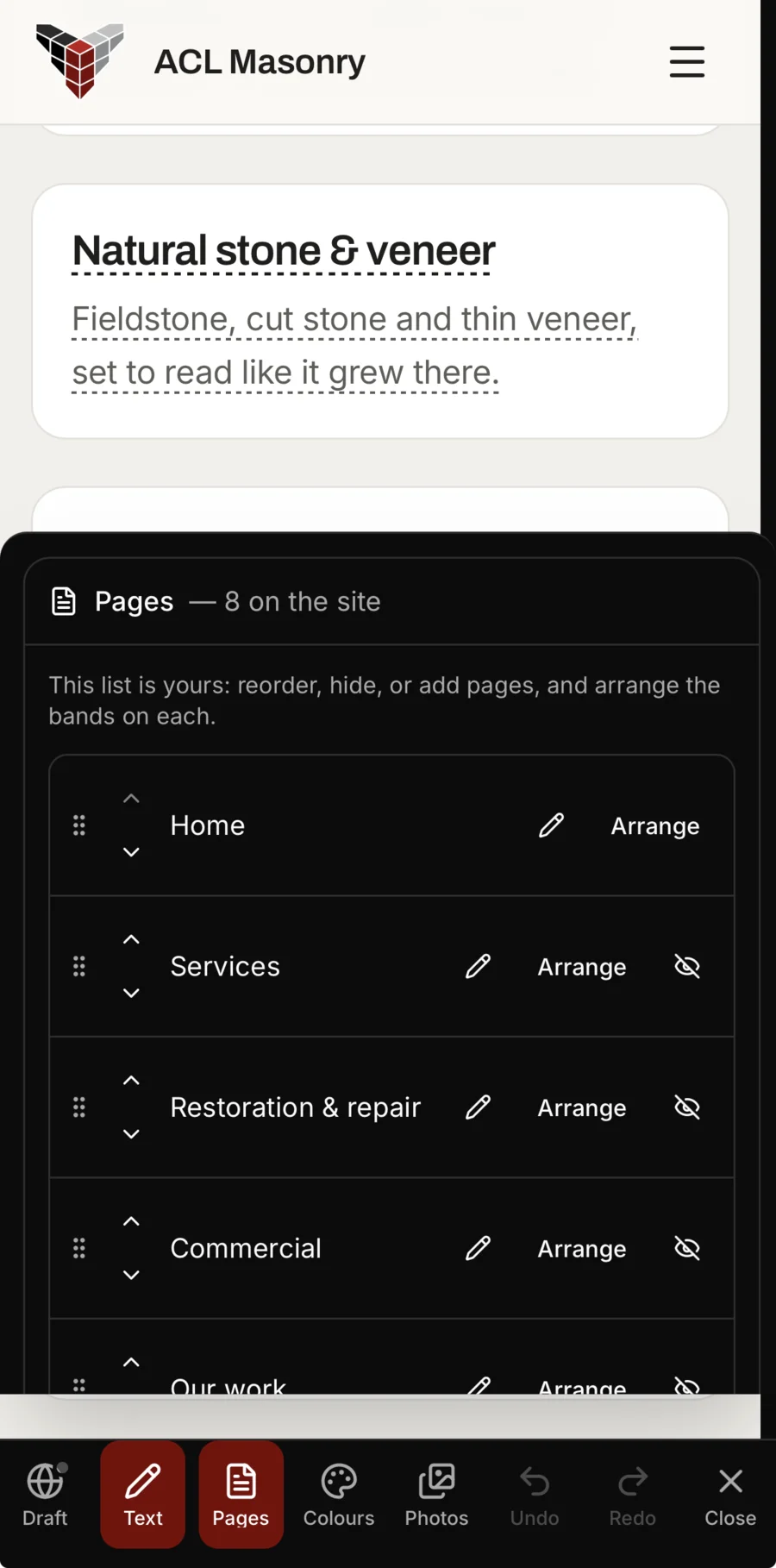
    The website editor with its Pages list open, 8 on the site: Home, Services, Restoration & repair, Commercial and Our work, each with a pencil, Arrange and an eye to hide it, above the tools Draft, Text, Pages, Colours, Photos, Undo, Redo and Close.
  • Every job, step by step

    Where every job stands, and the next step one tap away. Trades

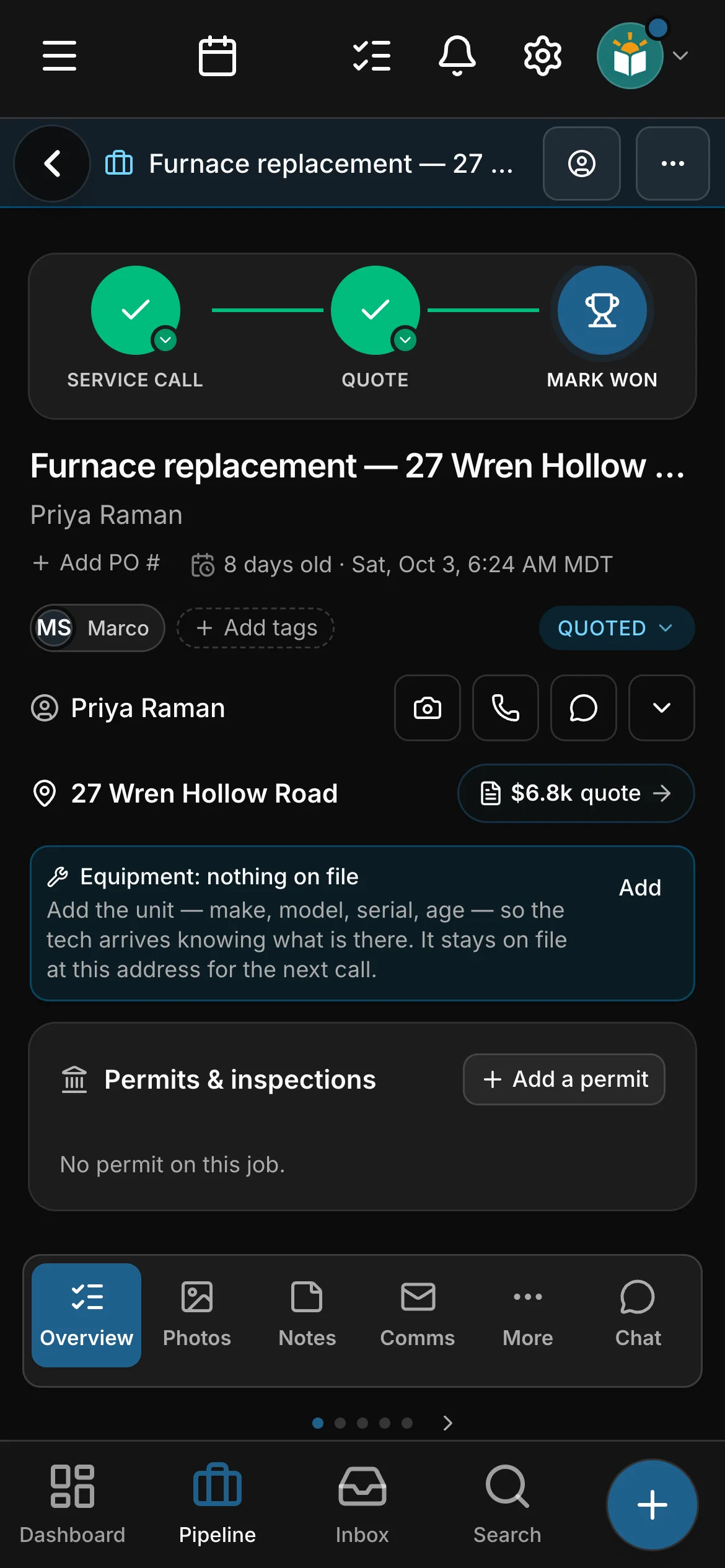
    A job’s steps across the top of its page: Site visit, Quote, Mark won and “Front steps rebuild — 27 Wren Hollow Road”.
  • Their own page

    Clients check it and pay it themselves.
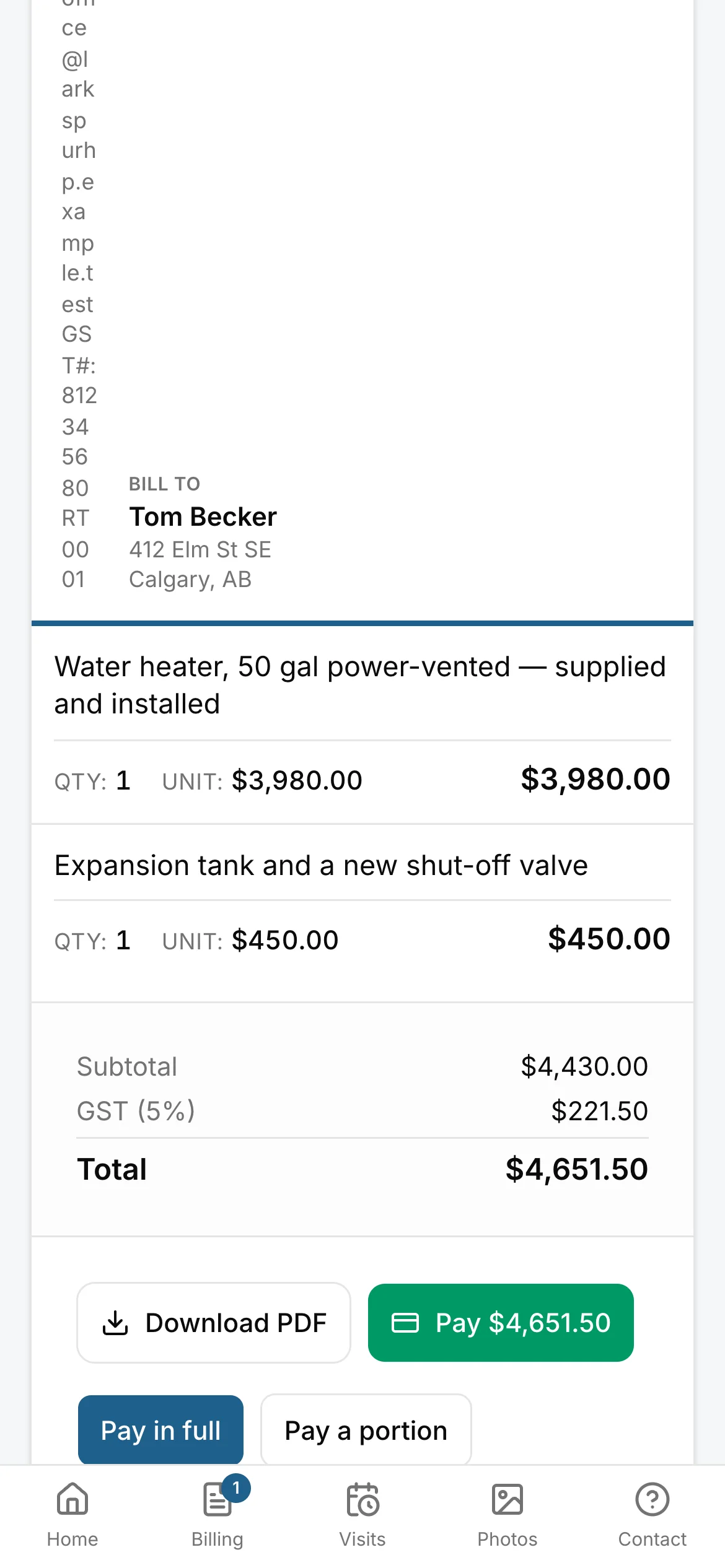
    A client’s own invoice on their page: INV-0098, $5,071.50 owing and down to “Pay $5,071.50”.
    Helen Fraser’s own page, opened from her link: Your quote is ready, Review & approve, Quotes, Invoices and Appointments.
  • Flag a teammate

    Hand it to the right person, with a note.

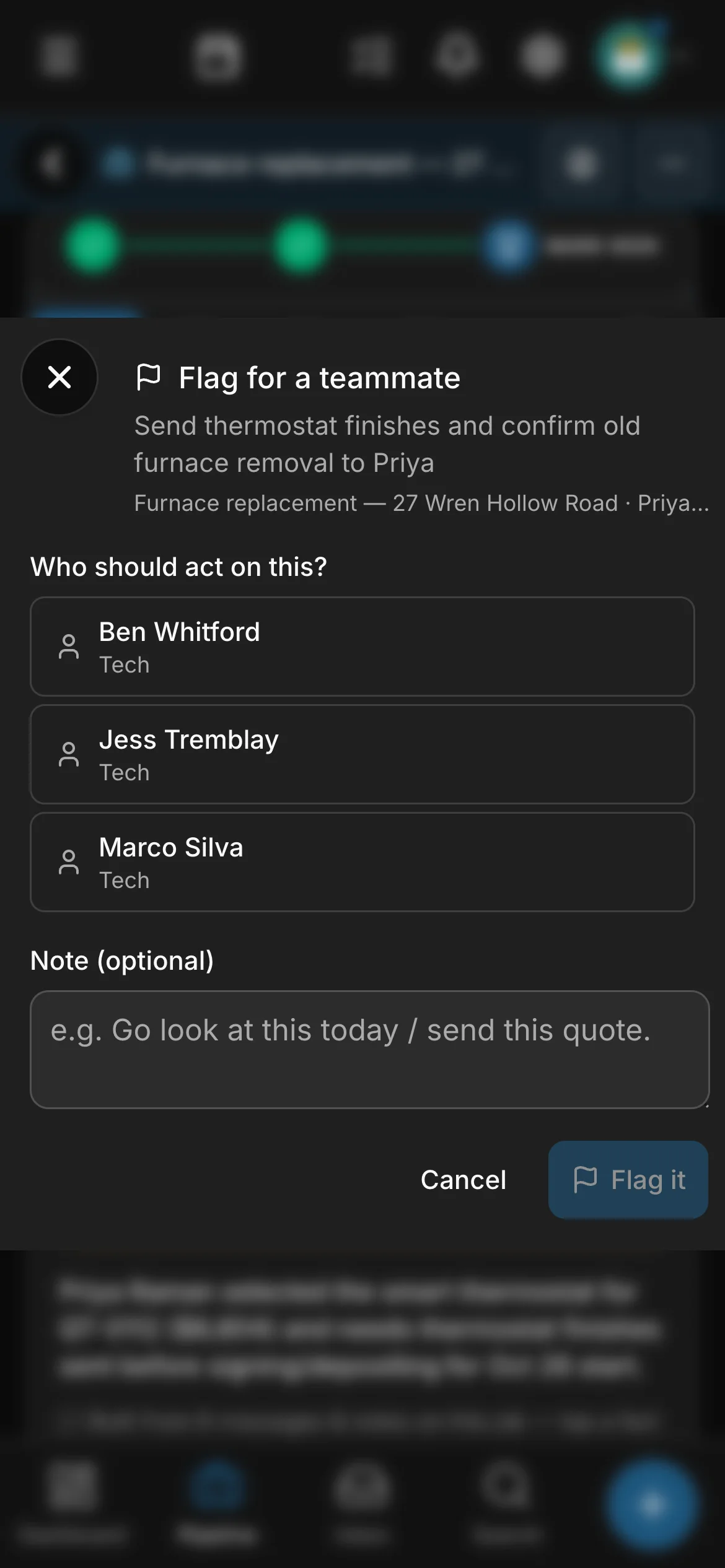
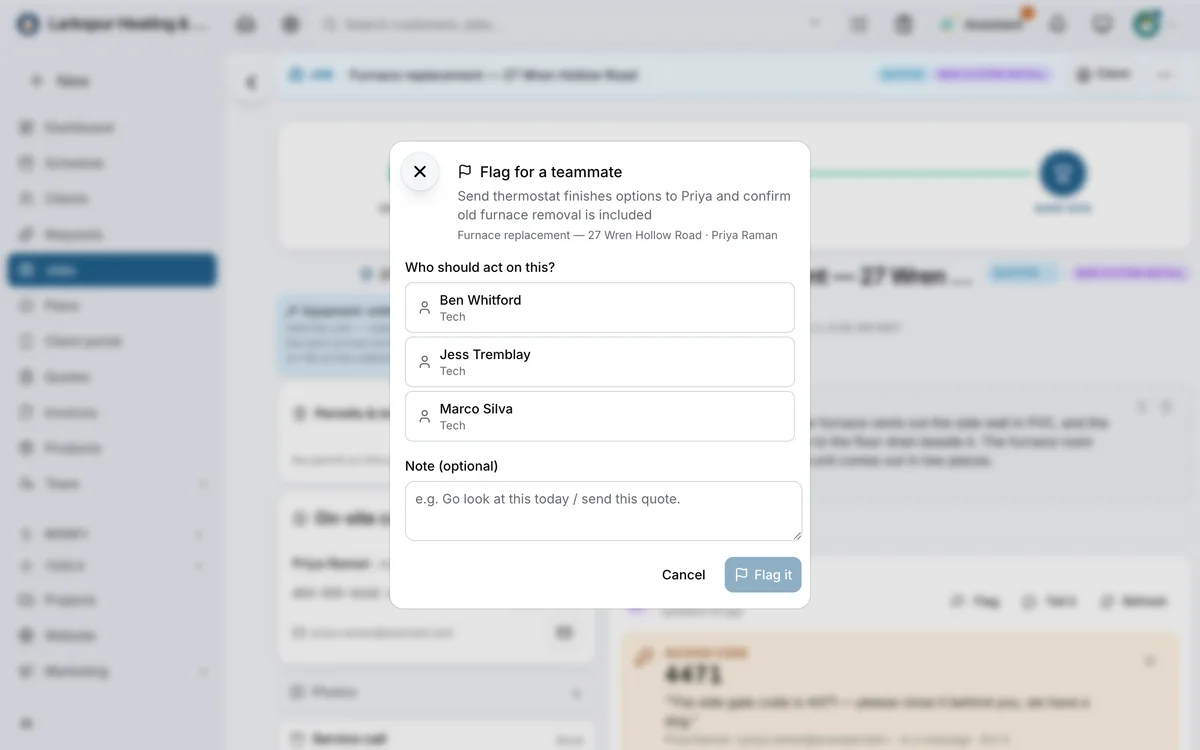
    A line of a job’s brief flagged for a teammate: “Flag for a teammate” — “Who should act on this?”, “Ben Whitford”, “Jess Tremblay” and “Marco Silva”.
    A line of a job’s brief flagged for a teammate: “Flag for a teammate” — “Who should act on this?”, “Ben Whitford”, “Jess Tremblay” and “Marco Silva”.
  • Before you go

    The gate code, on the crew’s phone before they knock. Trades

    The crew app’s “Before you go” on Priya’s front steps: the gate code pinned large, then the facts a crew can use — “Priya Raman prefers a text over a call, after 4 pm on weekdays” and “Measured on site: 5 risers and a 4 by 6 ft landing. A buried downspout line runs under the left side of the steps, so that side is a hand dig”.

The Quote Builder

Answer what a foreman would ask. It prices the job. Trades

Pick the job, answer its questions, and the labour, the materials and the scaffolding price themselves — the same inputs, the same price, every time. The client sees one clean line; you see where every dollar comes from.

  • The Quote Builder asking what the job is: Chimney, Block, Brick, Natural stone, Manufactured stone and Thin brick.

    Pick the job. Every built-in job type asks its own trade questions and does its own math.

  • The chimney’s tear-down step in the Quote Builder: “Rebuild: top 6 ft (≈390 bricks, new brick)”, All new brick, “≈ 390 bricks to lay”, buy 437 and 60 sqft of face.

    Watch the takeoff happen. From the chimney’s size it works out the bricks to lay and to buy; the total follows every answer.

  • The Quote Builder’s summary: “Where every dollar comes from (internal)”, Crew wages, Payroll burden, Overhead, Materials (cost), Profit (margin) $870.38 and Customer total $4,860.96.

    One clean line for the client. The whole story for you — crew wages, payroll burden, overhead — before you send.

  • Every built-in job type asks its own trade questions
  • The takeoff worked out from the answers, with the running total
  • Every assumption listed in one place, yours to change
  • Your cost and margin beside the line — never on the client’s PDF
Quoting

Your shop

Sell it online. Never sell what you don’t have.

Put your products or your merch up for sale in your own shop — a photo for each colour, sizes in a tap, and stock counted by colour and size, so the shop never sells past what you have.

  • Adding a hoodie to the products, Colours & sizes: Black and White, each with its photo, the black one starred to show first in the shop, and the sizes Adult L, XL and XXL, each with what it adds to the price.

    Colours and sizes. A photo for each colour, youth or adult sizes in a tap, and a little more for the big ones.

  • The hoodie’s Price & stock: 60 each, a price for each colour, Sell online in the shop and in Quick sale, and Count stock, with “Only … left” shown at 5.

    Count it. Stock by colour and size — your shop never sells more than you have, and says “Only 2 left” when a size runs low.

  • The Company hoodie’s own page with two colours picked to compare, the white and the black side by side, then its description, its sizes and a Show in your shop switch.

    Its own page. Every colour, its sizes, and one switch to show it in your shop or hide it.

  • Stock counted by colour and size; the shop never oversells
  • “Only 2 left” when a size runs low
  • One switch to show a product in your shop or hide it
  • On the middle and top plans of every rate card; an add-on on the first
Website & marketing

The +

One button that knows the page you’re on.

On a phone, the + in the bottom bar offers what the page in front of you needs next — on an invoice, a payment or a reminder; on a trade’s job, its next step first. On a computer, the same moves are under New.

  • The create button open in the office app: “Quick capture”, “Ballpark”, “New request”, “New client”, “Book visit”, “Quote”, “Invoice” and “Expense”.

    The + on every phone screen. A request, client, visit, quote, invoice or expense in two taps — and Quick capture on top for a note, a photo or a pasted message. Trades

  • The create button open on a job’s page: “Quick capture”, “Send reminder”, “Schedule work”, “New quote”, “Quote Builder”, “Generate invoice”, “Add photo”, “Task” and “On my way”.

    On a job, its next moves. What comes next first — here, a reminder for the overdue invoice — then scheduling the work, a quote, an invoice, a photo, a task or On my way. Trades

  • The create button open on an invoice: “Quick capture”, “Record payment”, “Send reminder” and “Make a copy”.

    On an invoice, the invoice’s. Record a payment, send a reminder or make a copy.

  • On a trade’s job, its next step first
  • On an invoice: record a payment, send a reminder, make a copy
  • On a computer, the same list under New
Automations

Your website

Your website, changed from your phone.

Every plan comes with a website started from pages written for your kind of work. Rename, reorder or hide a page, and change any line by tapping it — live when you press Publish.

  • The website editor with its Pages list open, 8 on the site: Home, Services, Restoration & repair, Commercial and Our work, each with a pencil, Arrange and an eye to hide it, above the tools Draft, Text, Pages, Colours, Photos, Undo, Redo and Close.

    Your pages. Rename, reorder or hide a page, add one, and arrange the bands on each.

  • Change this wording, open over a website’s Our work page: a box for the words, then how they look — size S to XL, the heading or body typeface, the weight and emphasis, and the alignment.

    Your words. Tap a heading or a line to write your own, then set its size, typeface, weight and alignment.

  • Included on every plan
  • Pages written for your kind of work to start from
  • Tap a heading or a line to write your own
  • Live when you press Publish
Website & marketing

Every job, step by step

Where every job stands, and the next step one tap away. Trades

Across the top of every job: the steps done, each keeping its history, and the next one as a button. Skip ahead when the work runs ahead of the paperwork.

  • The next step is a button — press it to do it
  • Skip ahead to a later step
  • Each step done keeps its history
Quoting

Their own page

Clients check it and pay it themselves.
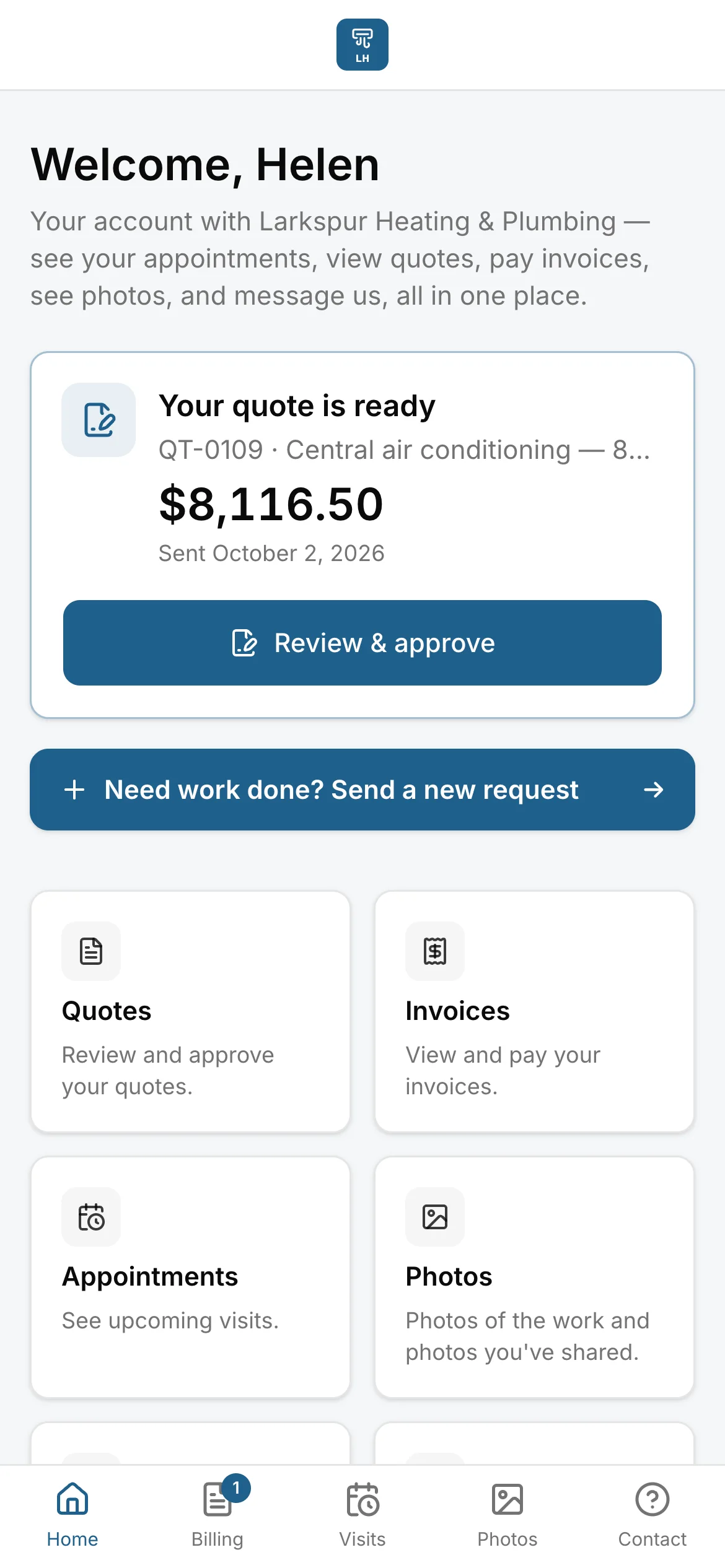
Every client gets their own page from a link — what they booked or were quoted, what they owe, their photos and a way to message you — so the questions and the payments come without a call to the office.

  • Helen Fraser’s own page, opened from her link: Your quote is ready, Review & approve, Quotes, Invoices and Appointments.

    Their own page. Your logo on top, their quote waiting for a yes, and a door to their invoices, visits, photos and messages. Trades

  • A client’s own invoice on their page: INV-0098, $5,071.50 owing and down to “Pay $5,071.50”.

    Paid from the invoice. By card, in full or a portion, without a call to the office.

  • Opened from the link you send them
  • Invoices paid by card, in full or a portion, where you take cards
  • Their messages land in your inbox
  • Your logo on top
Their own page

Flag a teammate

Hand it to the right person, with a note.
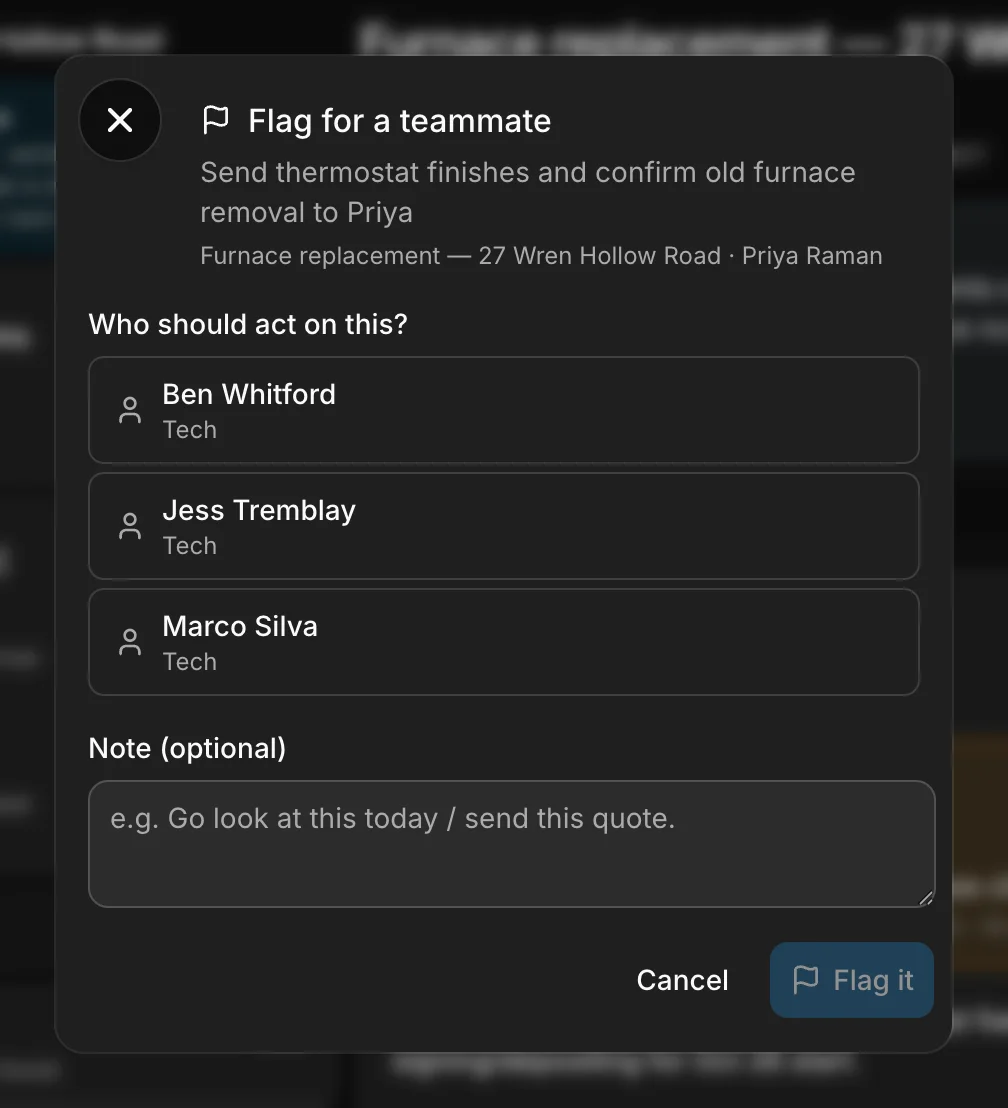
Flag a line of the Assistant’s list, a job’s brief, an email or a text for a teammate, and say what you need. It lands on their dashboard and on their phone.

  • From the Assistant’s list, a job’s brief, an email or a text
  • A push to their phone, and a “Flagged for you” card on their dashboard
  • The crew see theirs in Your day, under Flags
Communications

Before you go

The gate code, on the crew’s phone before they knock. Trades
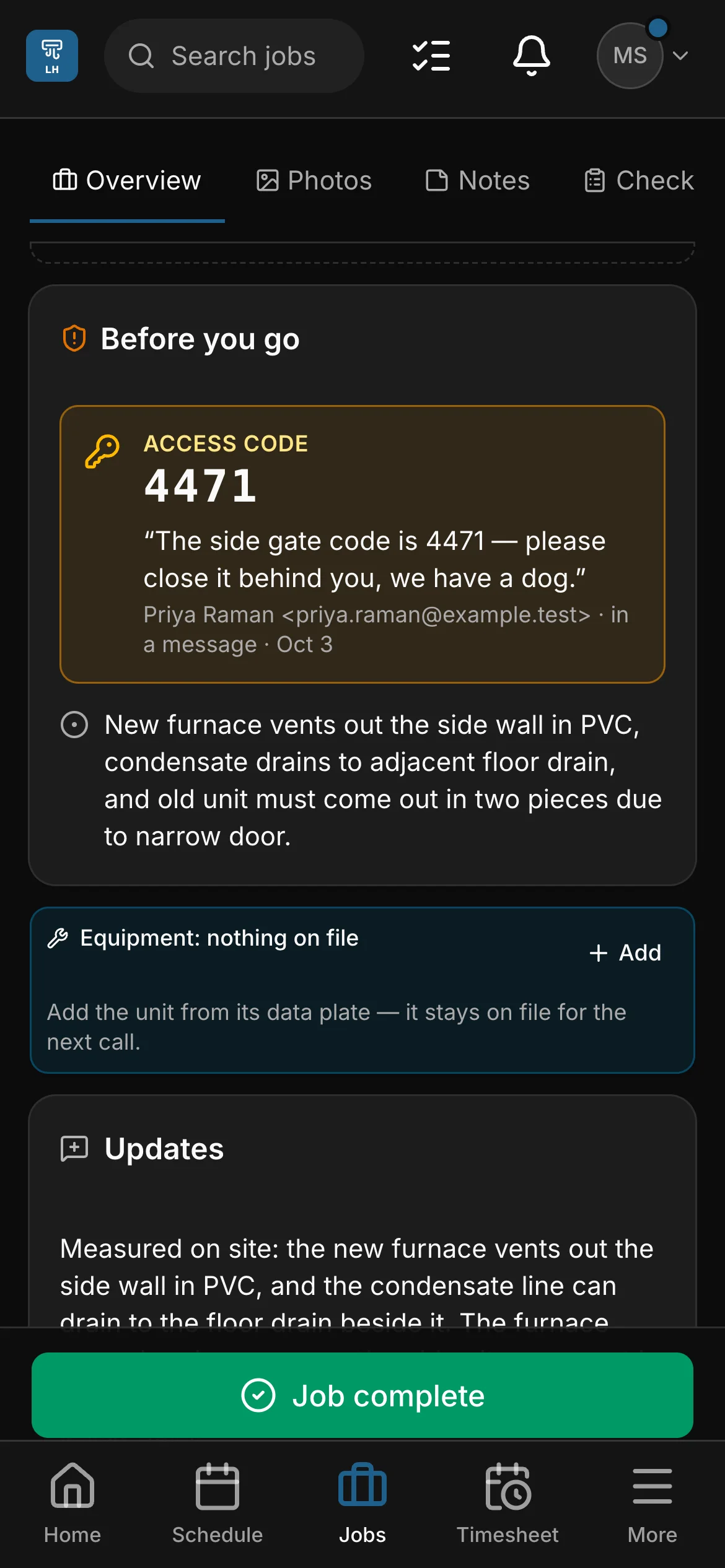
The gate code a client mentions in an email, and the facts a crew needs on site, are pinned by the job’s brief — and the crew’s phone shows them under “Before you go”. Never the money.

  • The access code, large, at the top
  • The facts for the site, from the job’s emails and notes
  • Never the money
The brief

The work around the work.

The conversations, the paperwork, the schedule, the field and the books — the parts of running a business nobody started it to do. Here is each one in Daybook, screen by screen.

Every conversation

Every message, filed where it belongs.

Email, texts and what clients send from their own page land in one inbox, and mail from a client’s address is filed on that client by itself. Anything still waiting on your reply goes on the Assistant’s list, and a teammate you flag sees it on their dashboard until it’s done.
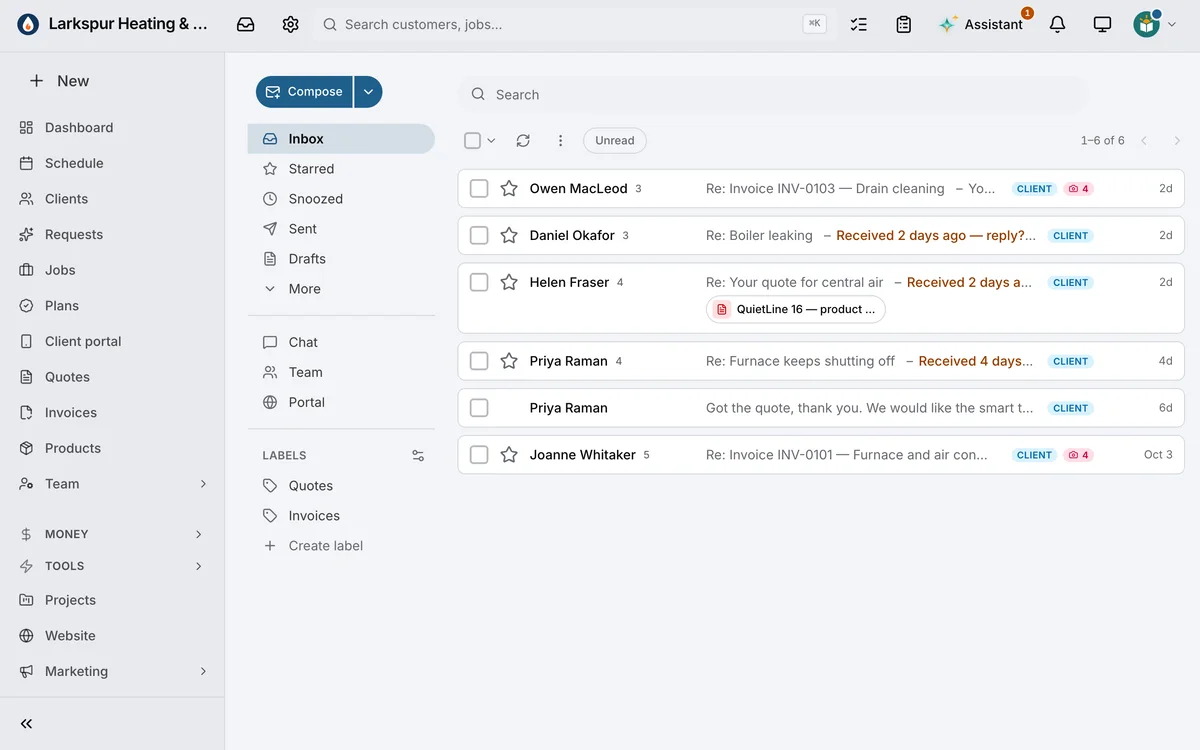
The inbox in Daybook, every conversation marked as a client’s: Owen MacLeod, Helen Fraser, Daniel Okafor, Priya Raman and Tom Becker.
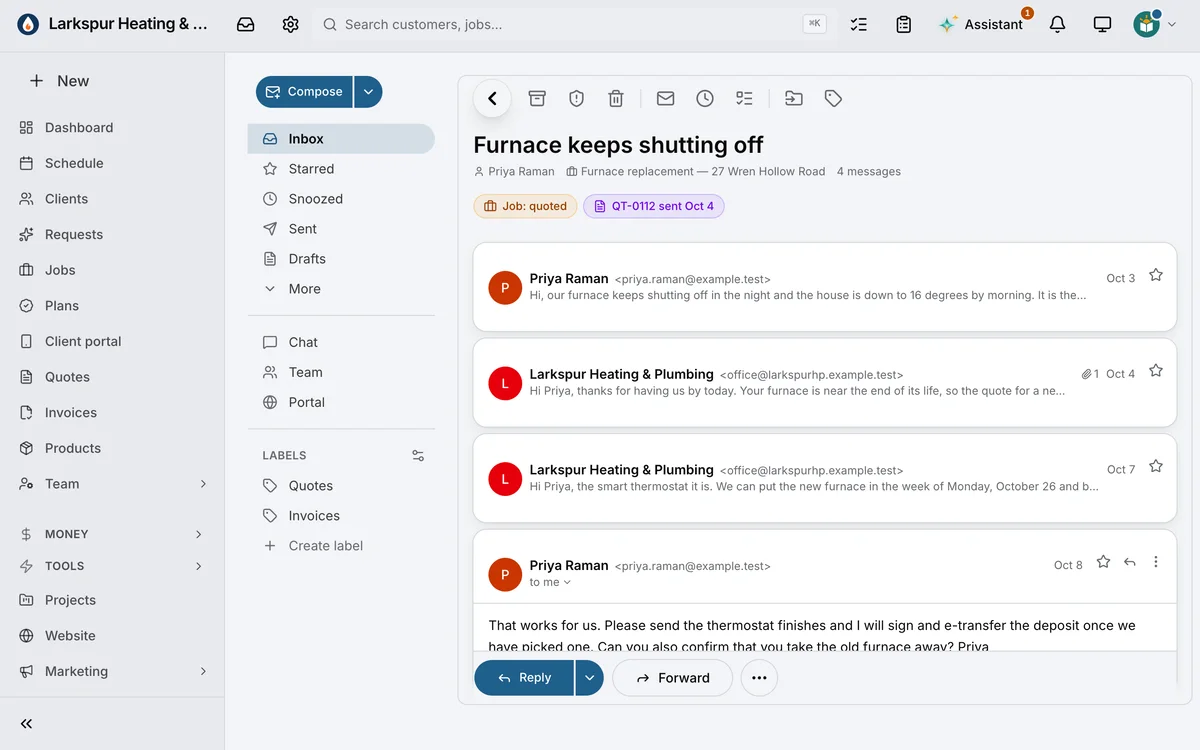
An email conversation on its job: “Front steps are crumbling”, between Priya Raman and Larkspur Masonry, down to the Reply bar.
  • One inbox. Every conversation newest first — email from a client’s address filed on that client by itself.
  • On the job it’s about. The whole conversation with the job and its quote above it, and a reply that’s yours to send. Trades
  • Your inbox, beside your list. Every conversation in the Assistant’s panel, each marked as a client’s, with a nudge on the ones waiting on a reply.
  • Flag it for a teammate. Pick who should act on it and add a note — it lands on their dashboard and their phone.

Every conversation

Every message, filed where it belongs.

Email, texts and what clients send from their own page land in one inbox, and mail from a client’s address is filed on that client by itself. Anything still waiting on your reply goes on the Assistant’s list, and a teammate you flag sees it on their dashboard until it’s done.
  • The inbox in Daybook, every conversation marked as a client’s: Owen MacLeod, Helen Fraser, Daniel Okafor, Priya Raman and Tom Becker.

    One inbox. Every conversation newest first — email from a client’s address filed on that client by itself.

  • An email conversation on its job: “Front steps are crumbling”, between Priya Raman and Larkspur Masonry, down to the Reply bar.

    On the job it’s about. The whole conversation with the job and its quote above it, and a reply that’s yours to send. Trades

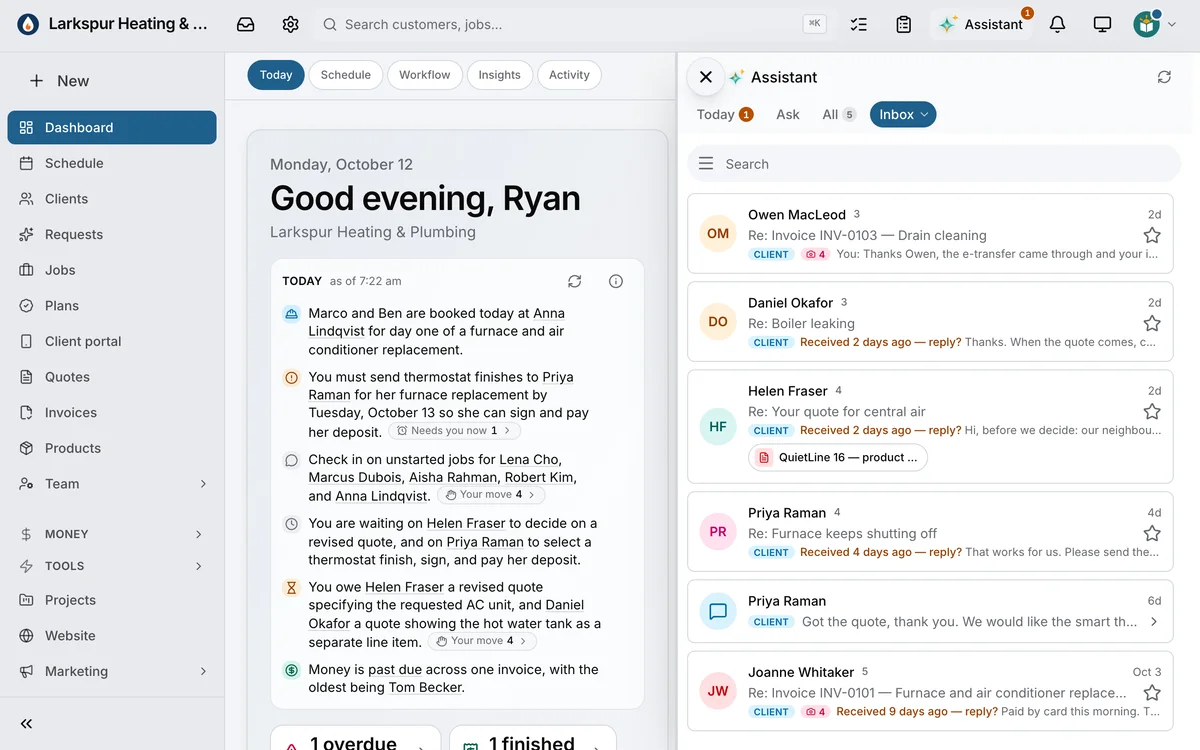
  • The Assistant’s Inbox tab, every conversation marked as a client’s: Owen MacLeod, Helen Fraser, Daniel Okafor and Priya Raman.

    Your inbox, beside your list. Every conversation in the Assistant’s panel, each marked as a client’s, with a nudge on the ones waiting on a reply.

  • A line of a job’s brief flagged for a teammate: “Flag for a teammate” — “Who should act on this?”, “Ben Whitford”, “Jess Tremblay” and “Marco Silva”.

    Flag it for a teammate. Pick who should act on it and add a note — it lands on their dashboard and their phone.

  • Email, texts and messages from the client’s own page, in one inbox
  • Mail from a client’s address filed on that client by itself
  • Texting from your business’s own number — an add-on, included on the top plans
  • On a trade’s job: one chat window for the office, the crew and the client
  • A client email waiting on your reply goes on the Assistant’s list
  • Flag anything for a teammate — it stays on their dashboard until it’s done
Communications

Capture

Stop retyping what clients send you.

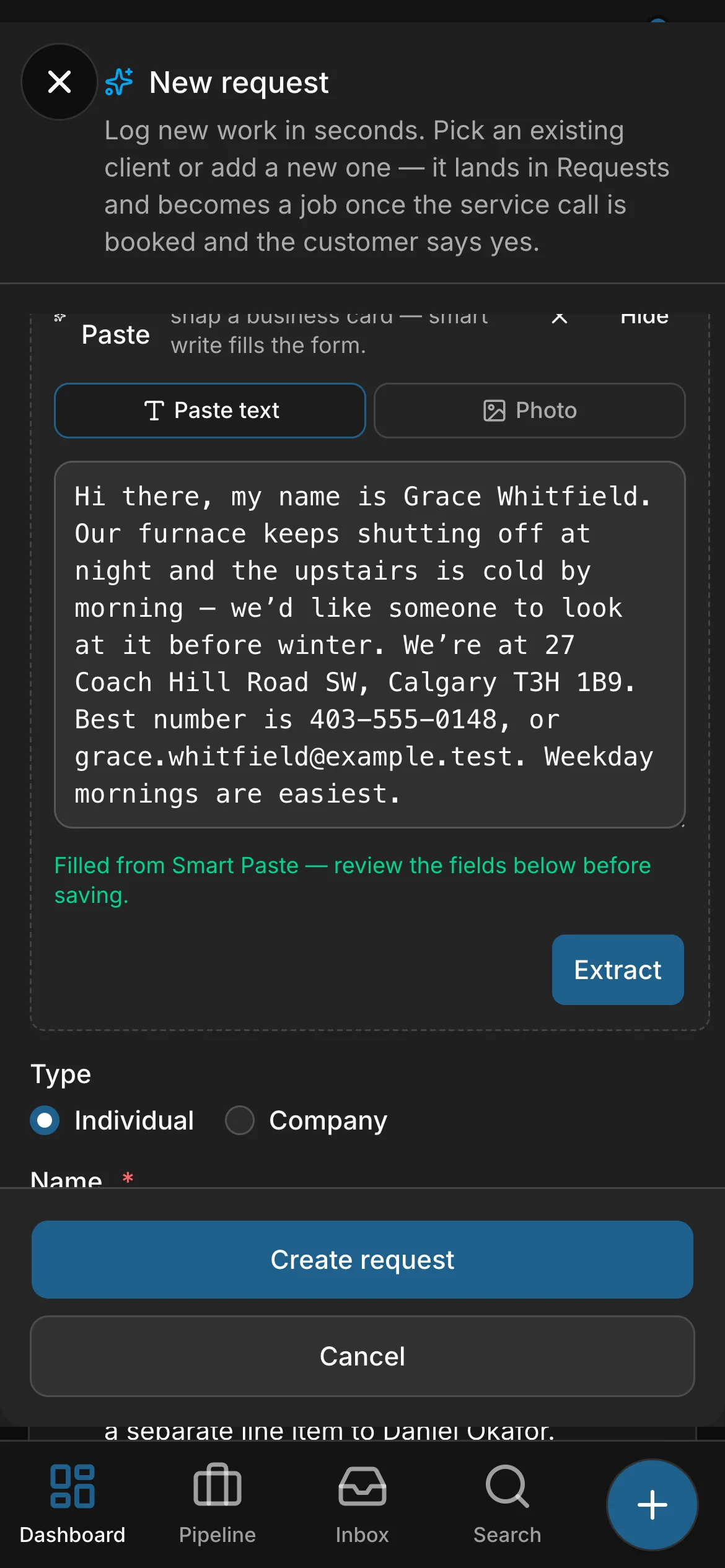
Paste a message, or snap a business card or a screenshot, and the new client fills itself in for you to check. On a phone, the + on every screen offers what that page needs next.

Smart Paste on a new request, an enquiry from Grace Whitfield pasted in: “Filled from Smart Paste — review the fields below before saving”.
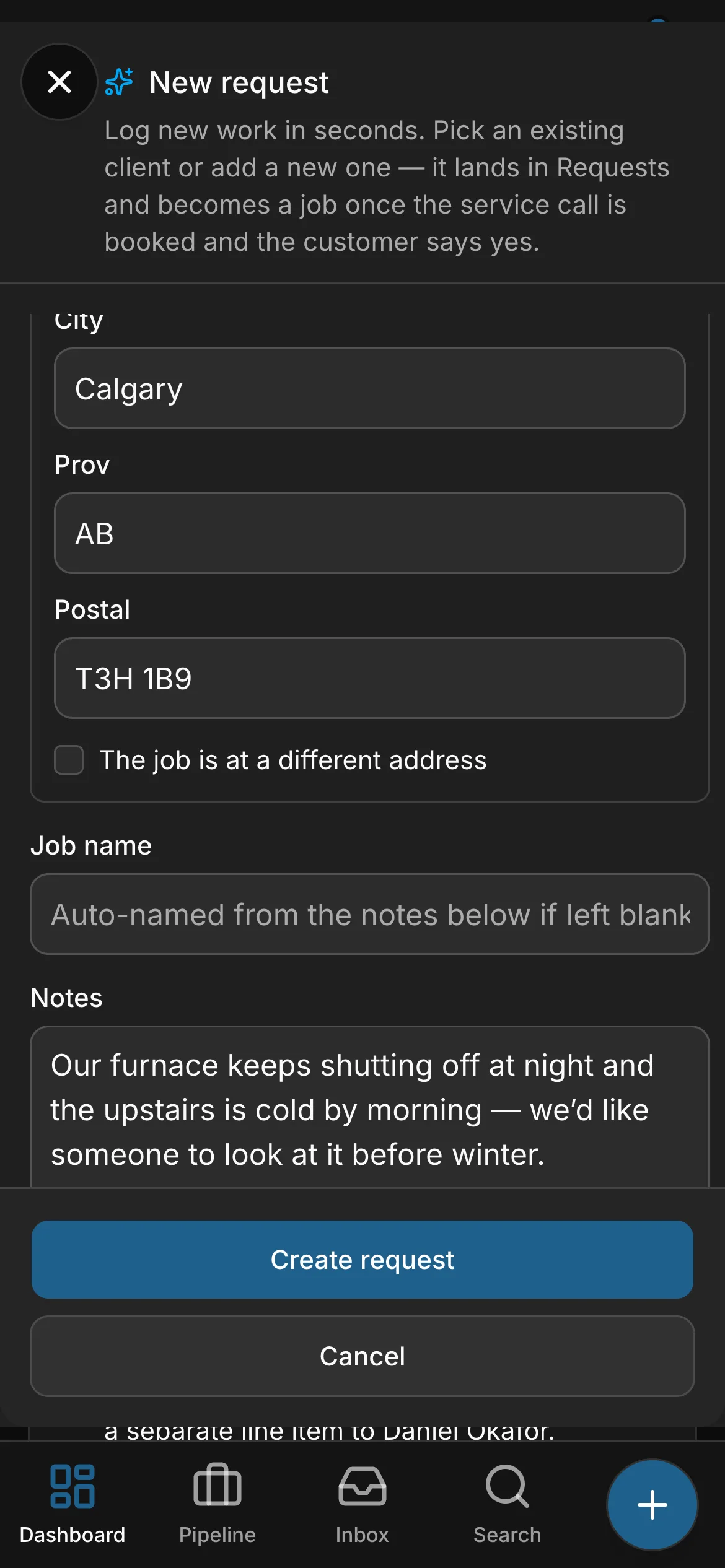
The same new request further down, the address and the work read in: the city, postal and notes filled in from it.
  • Paste the enquiry. An email, a text, a voicemail written out — or a photo of a business card. Trades
  • The form fills itself. The address and what they asked for too — and nothing is saved until you press Create request. Trades

Capture

Stop retyping what clients send you.

Paste a message, or snap a business card or a screenshot, and the new client fills itself in for you to check. On a phone, the + on every screen offers what that page needs next.

  • Smart Paste on a new request, an enquiry from Grace Whitfield pasted in: “Filled from Smart Paste — review the fields below before saving”.

    Paste the enquiry. An email, a text, a voicemail written out — or a photo of a business card. Trades

  • The same new request further down, the address and the work read in: the city, postal and notes filled in from it.

    The form fills itself. The address and what they asked for too — and nothing is saved until you press Create request. Trades

  • The create button open in the office app: “Quick capture”, “Ballpark”, “New request”, “New client”, “Book visit”, “Quote”, “Invoice” and “Expense”.

    The + on every phone screen. A request, client, visit, quote, invoice or expense in two taps — and Quick capture on top for a note, a photo or a pasted message. Trades

  • The create button open on a job’s page: “Quick capture”, “Send reminder”, “Schedule work”, “New quote”, “Quote Builder”, “Generate invoice”, “Add photo”, “Task” and “On my way”.

    On a job, its next moves. What comes next first — here, a reminder for the overdue invoice — then scheduling the work, a quote, an invoice, a photo, a task or On my way. Trades

  • The create button open on an invoice: “Quick capture”, “Record payment”, “Send reminder” and “Make a copy”.

    On an invoice, the invoice’s. Record a payment, send a reminder or make a copy.

  • Paste text, or snap a business card or a screenshot
  • Name, phones, emails and the address filled in for you to check
  • Nothing is saved until you press Create
  • The + on every phone screen offers that page’s next moves
Automations

The schedule

Six views. One calendar.

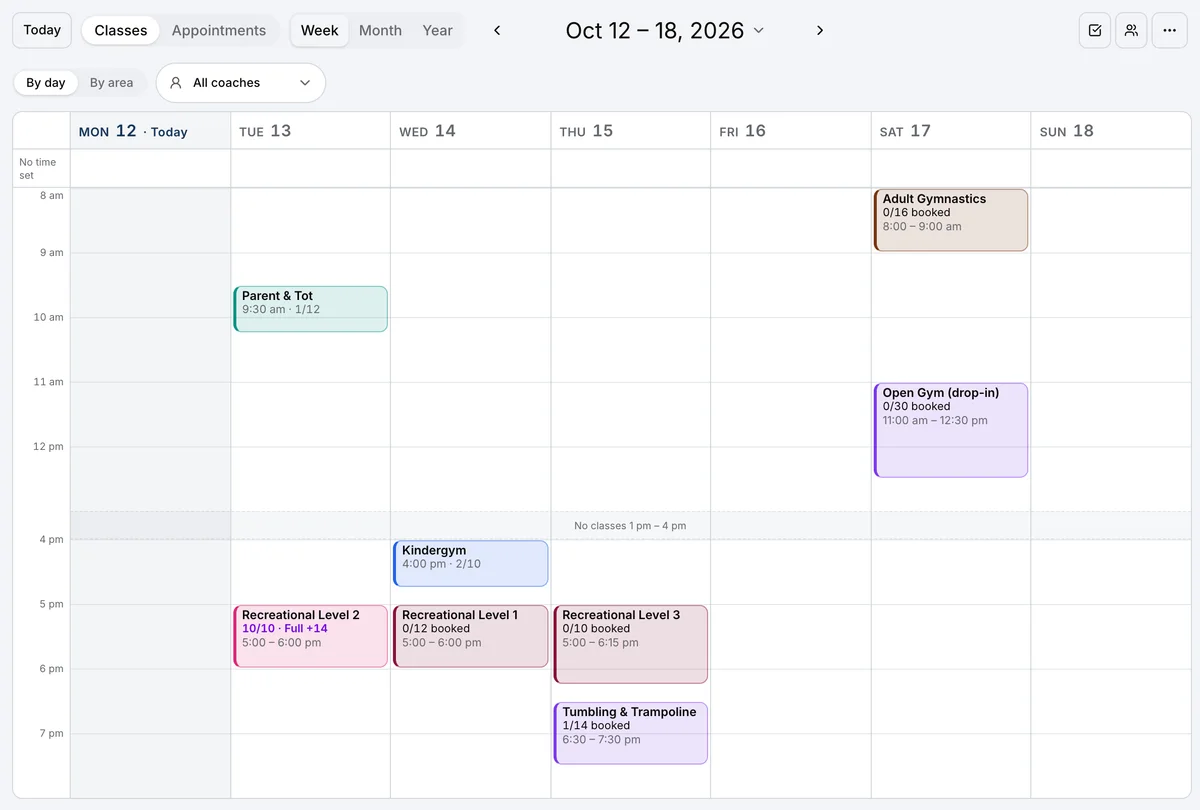
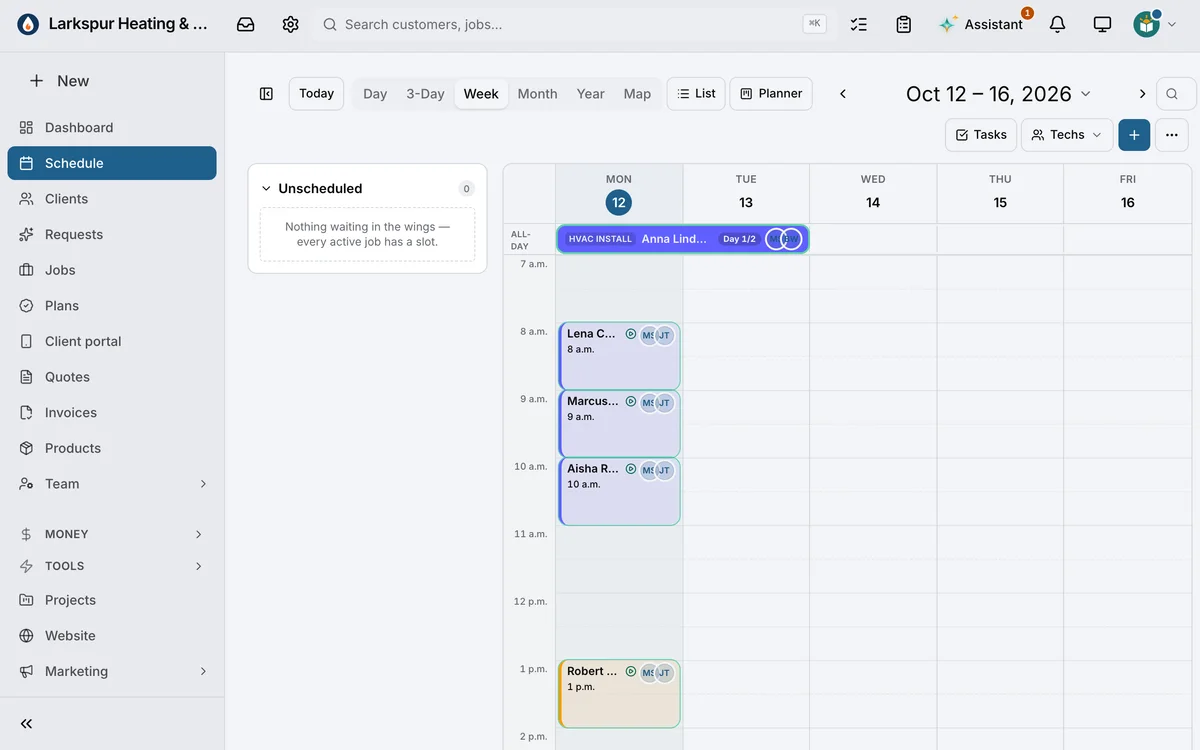
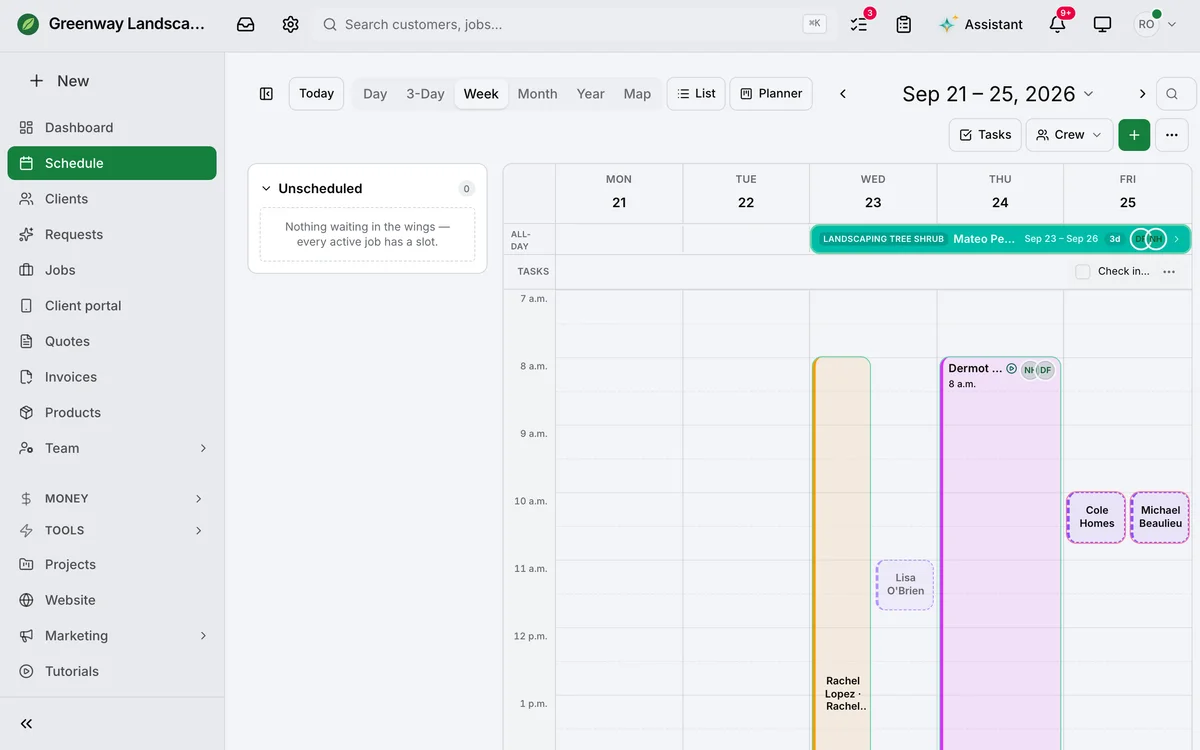
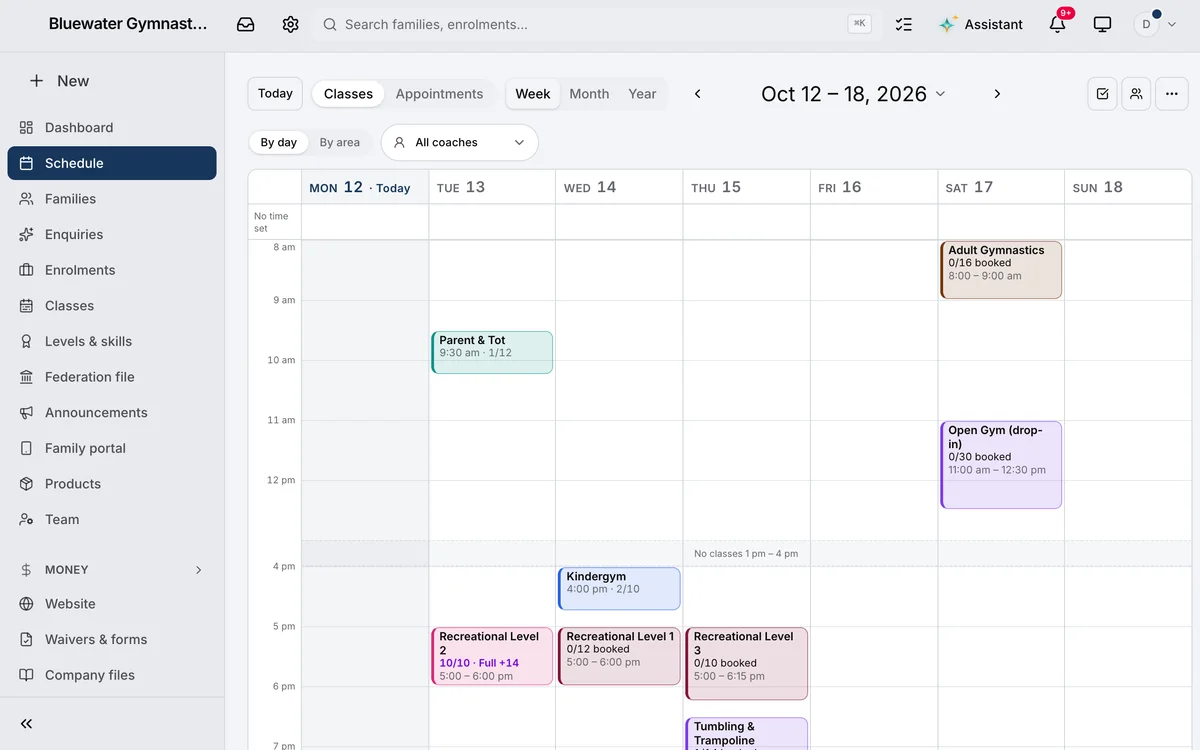
Day, week, month, the map, the dispatch board and the action list — six views of one calendar, so the office and the field are looking at the same picture. Everything you take on has a date.
The schedule

Six views. One calendar.

Day, week, month, the map, the dispatch board and the action list — six views of one calendar, so the office and the field are looking at the same picture. Everything you take on has a date.
  • A week of the schedule in Daybook: “Patio wall cap repair — 9 Juniper Bay” and “Chimney crown — 230 Ranchview Drive”.

    The week. Everything booked, on its day and its hour, with who is on it.

  • The requests board in Daybook: “Stone veneer on the front of the house — 41 Cranston Place” and “Brick mailbox rebuild — 12 Silverado Range Close”.

    Requests, ready to book. Each with its address and how long it has waited, the visit one tap away and a route planned from the same board. Trades

  • Day, week, month, map, dispatch board and action list — one calendar
  • Drag a job and whoever needs telling is told
  • The week board: who, when, and what to know before the day starts
  • A change here is on their screen in a second — nothing to sync
Scheduling

Field to office

What happened on site, already at the desk.

Clock-in, checklists and photos from the phone already in their pocket — with no signal, if it comes to that; it files itself when the signal returns. The office sees it the moment it lands.

Their day

Their hours, today’s work and every job a tap away, on the phone already in their pocket.

The job Trades

Call the client or get directions, chat with the office, ask for materials or a change order, and add photos.

Safety first Trades

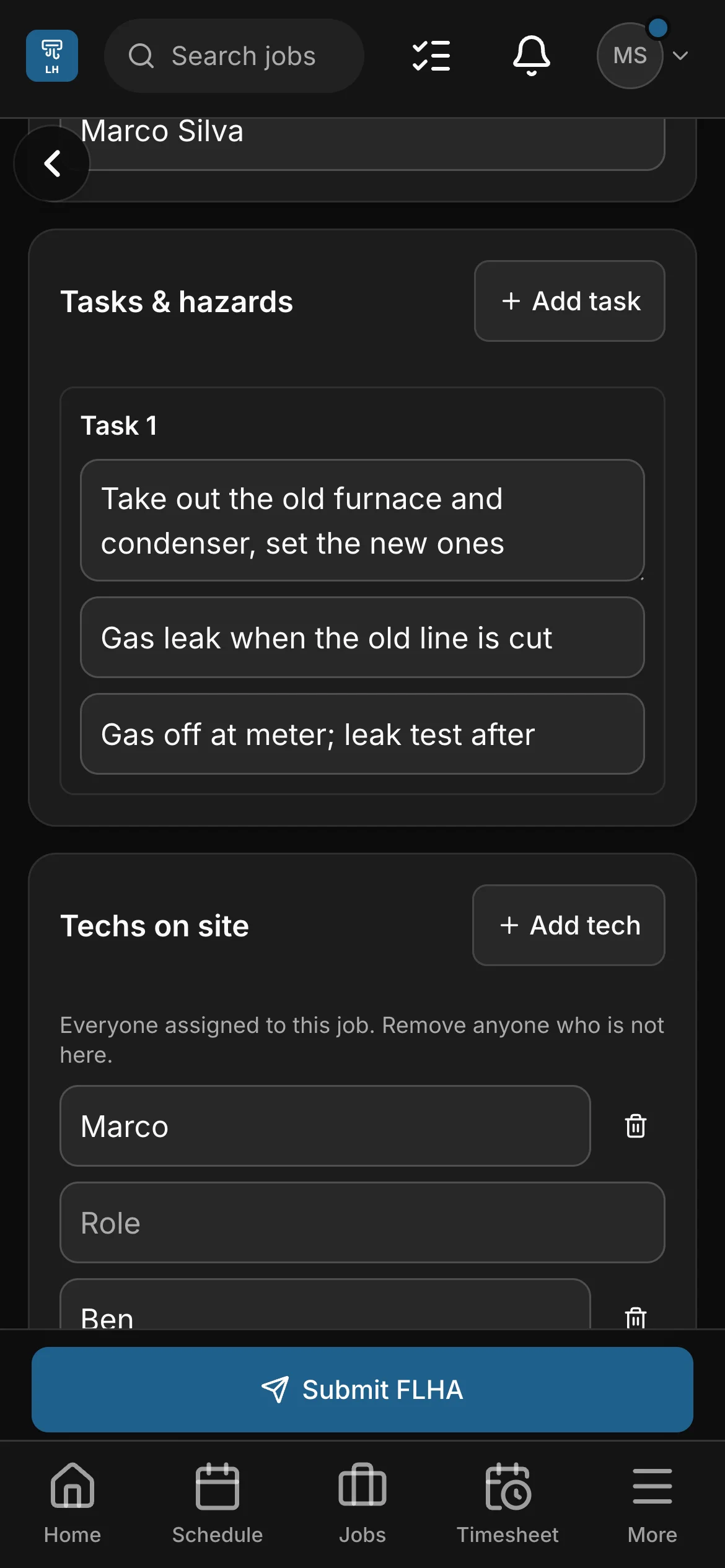
The FLHA opens from the job with the site, the contact and the crew filled in — they add the task, the hazard and the control.

Hours in

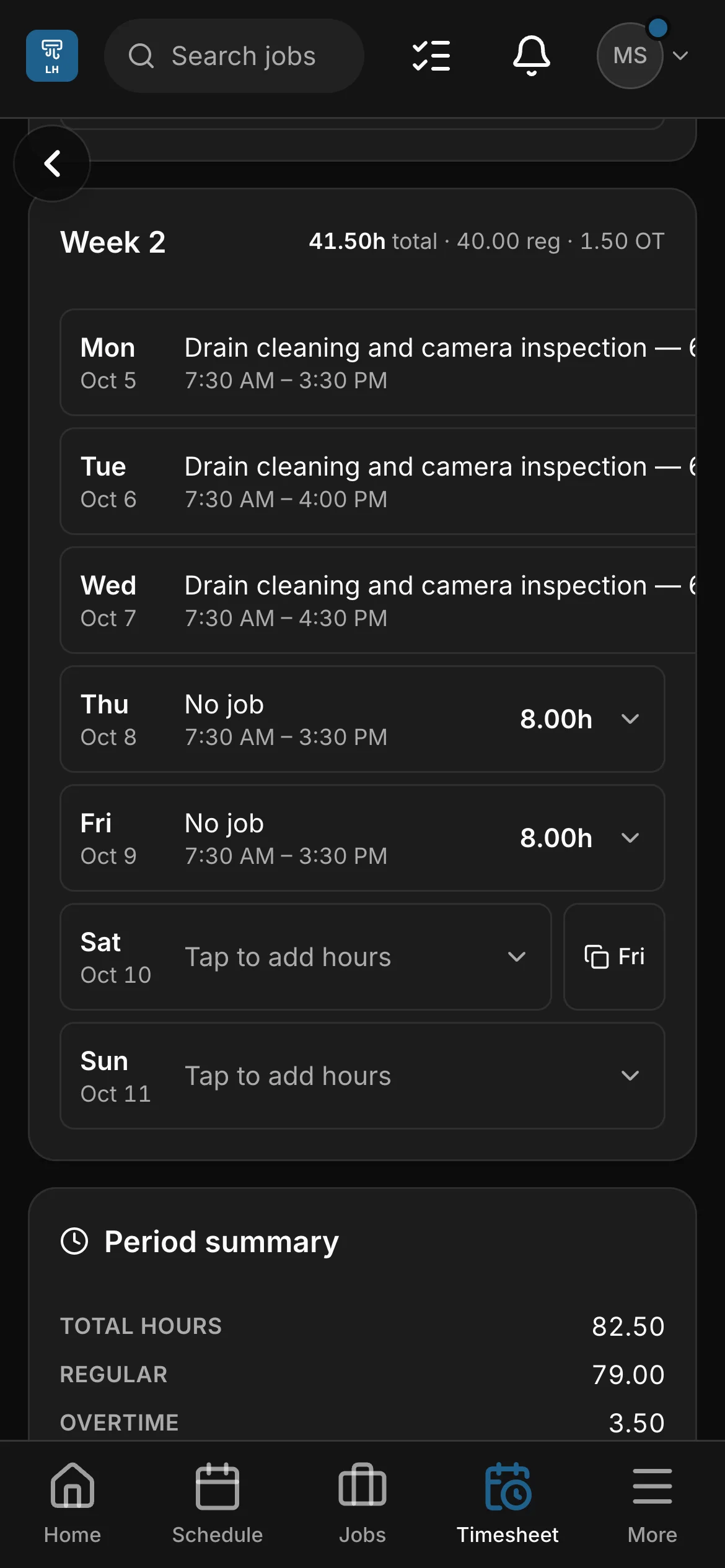
Day by day for the pay period, overtime worked out by your rule, then submitted from the phone.

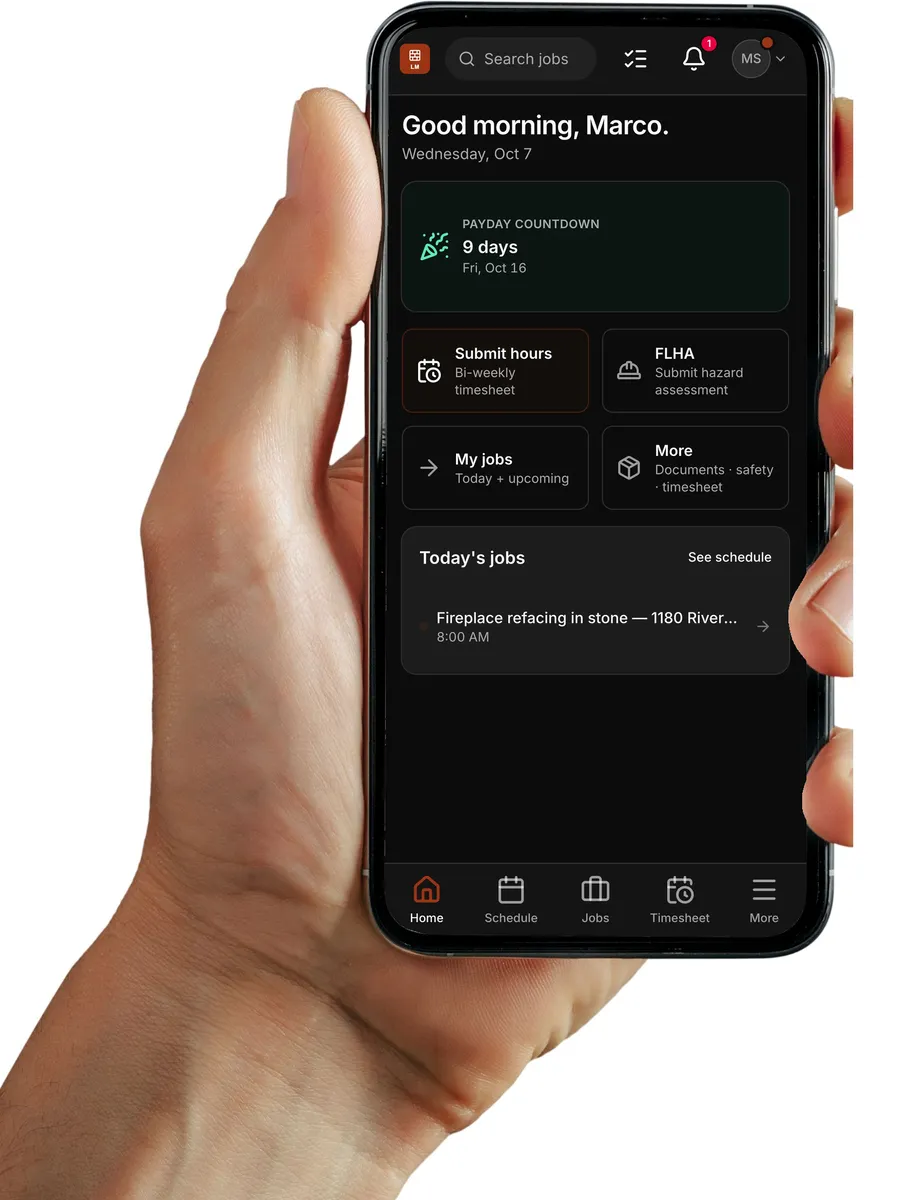
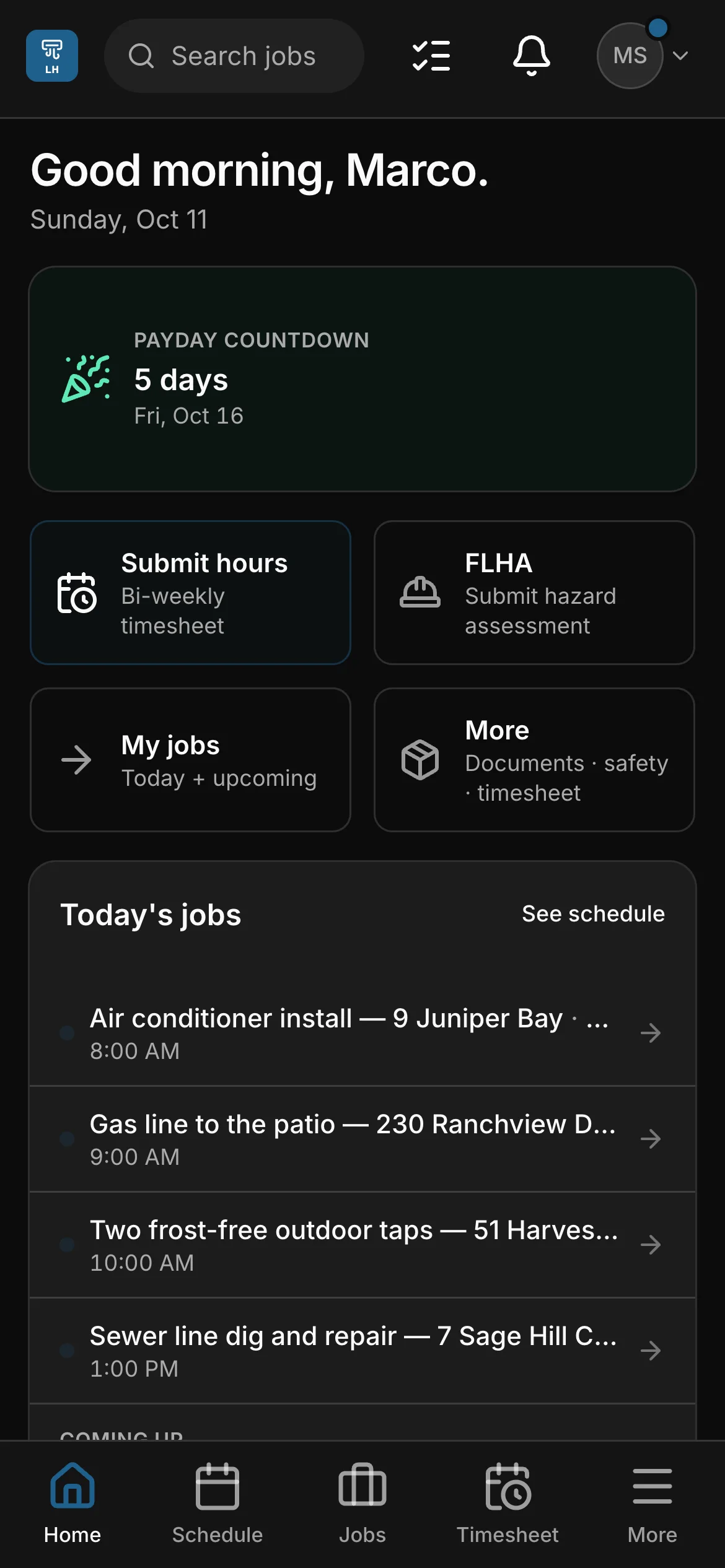
Marco’s home in the crew app: a greeting by name, the days to the next payday, then Submit hours, FLHA, My jobs and More, and today’s jobs under them.
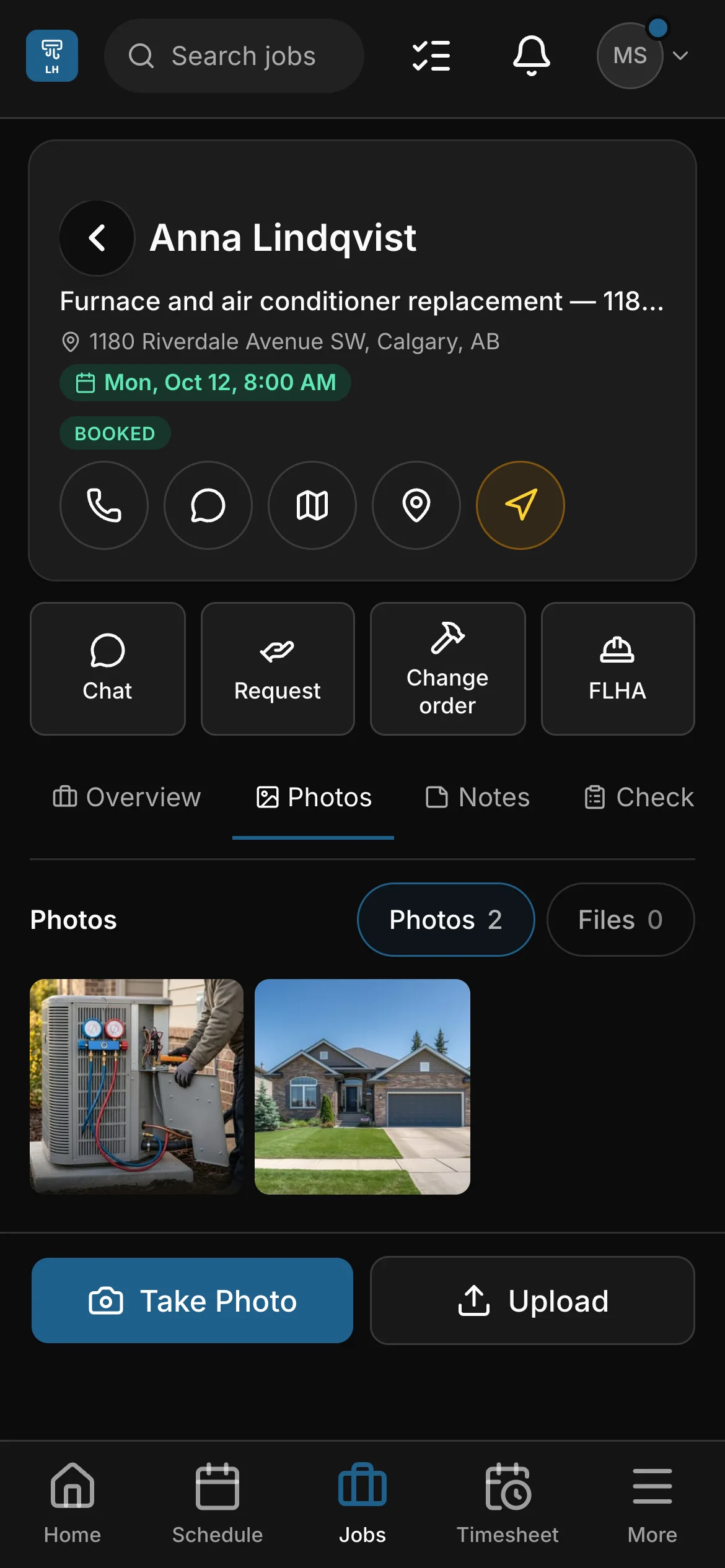
Anna Lindqvist’s fireplace job in the crew app, on its Photos tab: Chat, Request, Change order and FLHA.
An FLHA on Marco’s phone for the fireplace job, “Strip the brick face off the fireplace and set the stone”: the task with its hazard and its control, and the crew on site under it.
Marco’s timesheet in the crew app, the second week of the pay period: 2 days with their hours, then the period’s total, regular and overtime hours.

Field to office

What happened on site, already at the desk.

Clock-in, checklists and photos from the phone already in their pocket — with no signal, if it comes to that; it files itself when the signal returns. The office sees it the moment it lands.

  • Marco’s home in the crew app: a greeting by name, the days to the next payday, then Submit hours, FLHA, My jobs and More, and today’s jobs under them.

    Their day. Their hours, today’s work and every job a tap away, on the phone already in their pocket.

  • Anna Lindqvist’s fireplace job in the crew app, on its Photos tab: Chat, Request, Change order and FLHA.

    The job. Call the client or get directions, chat with the office, ask for materials or a change order, and add photos. Trades

  • An FLHA on Marco’s phone for the fireplace job, “Strip the brick face off the fireplace and set the stone”: the task with its hazard and its control, and the crew on site under it.

    Safety first. The FLHA opens from the job with the site, the contact and the crew filled in — they add the task, the hazard and the control. Trades

  • Marco’s timesheet in the crew app, the second week of the pay period: 2 days with their hours, then the period’s total, regular and overtime hours.

    Hours in. Day by day for the pay period, overtime worked out by your rule, then submitted from the phone.

  • Clock-in and timesheets from the phone in their pocket
  • Checklists your team fills in on the job — with a signature if you want one
  • Safety forms for the trades that need them
  • Photos taken where there is no signal, filed when it returns
  • Tasks with a due date, assigned to a person
The crew app

Paperwork

The report writes itself from the job. Trades

For the trades: an inspection report, a work plan, an O&M manual, a warranty or a closeout package, drafted from the job’s notes, messages and quote and from the company files you’ve added — with the photos that back up your findings. You read it, change what you like, and send it.

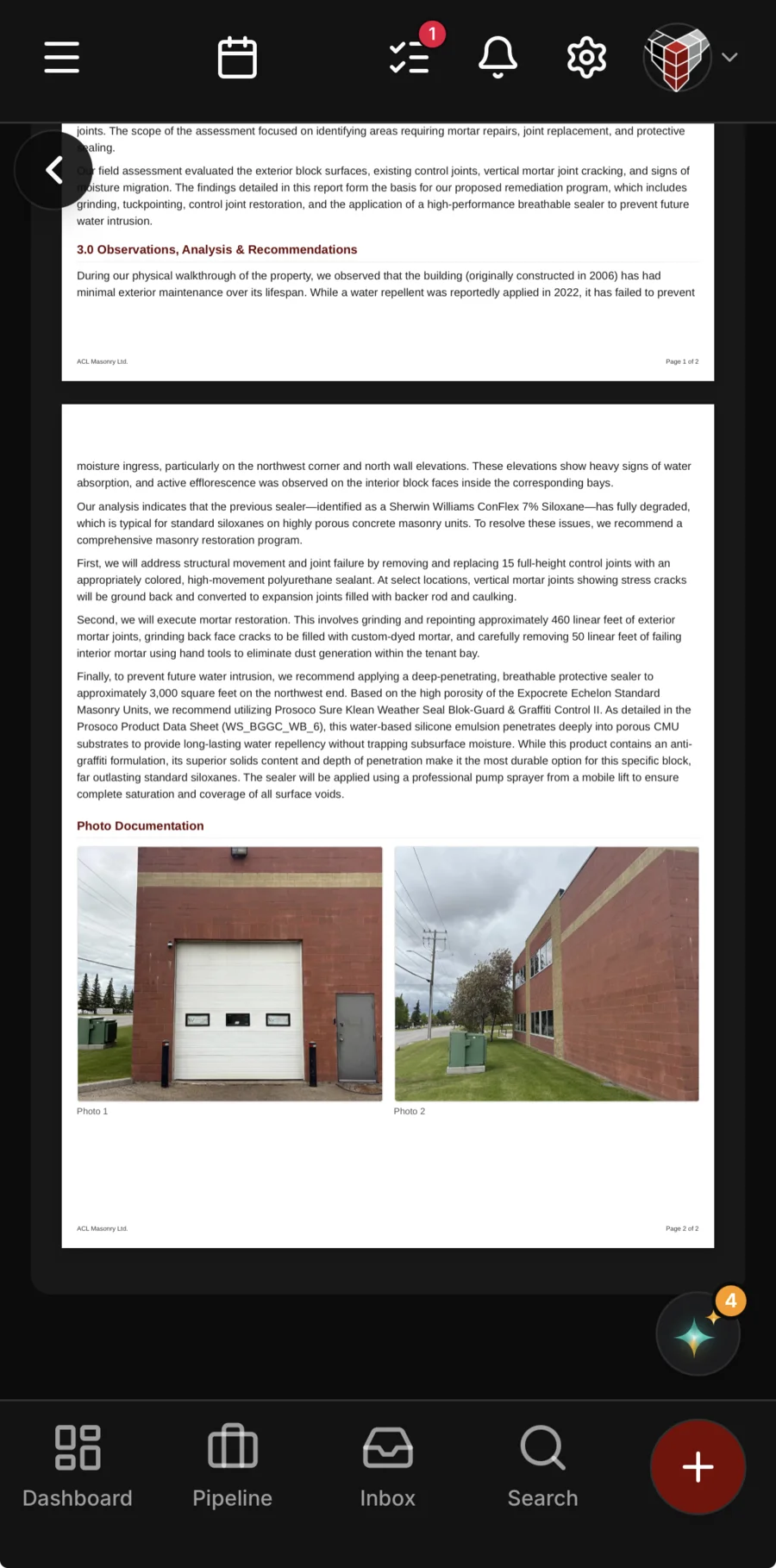
An inspection report as its PDF: the observations and the recommended repairs to a block building, then Photo Documentation — two photos of the building, captioned Photo 1 and Photo 2.
  • With the job’s photos. Pick them yourself, or let Daybook choose the ones that back up your findings and caption them. Trades

Paperwork

The report writes itself from the job. Trades

For the trades: an inspection report, a work plan, an O&M manual, a warranty or a closeout package, drafted from the job’s notes, messages and quote and from the company files you’ve added — with the photos that back up your findings. You read it, change what you like, and send it.

  • A job’s page in the app: its Documents card with an inspection report sent to the client, and the New menu open — Work Plan, Inspection Report, O&M Manual, Warranty and Closeout Package.

    Pick the document. A work plan, inspection report, O&M manual, warranty or closeout package, from the job it belongs to. Trades

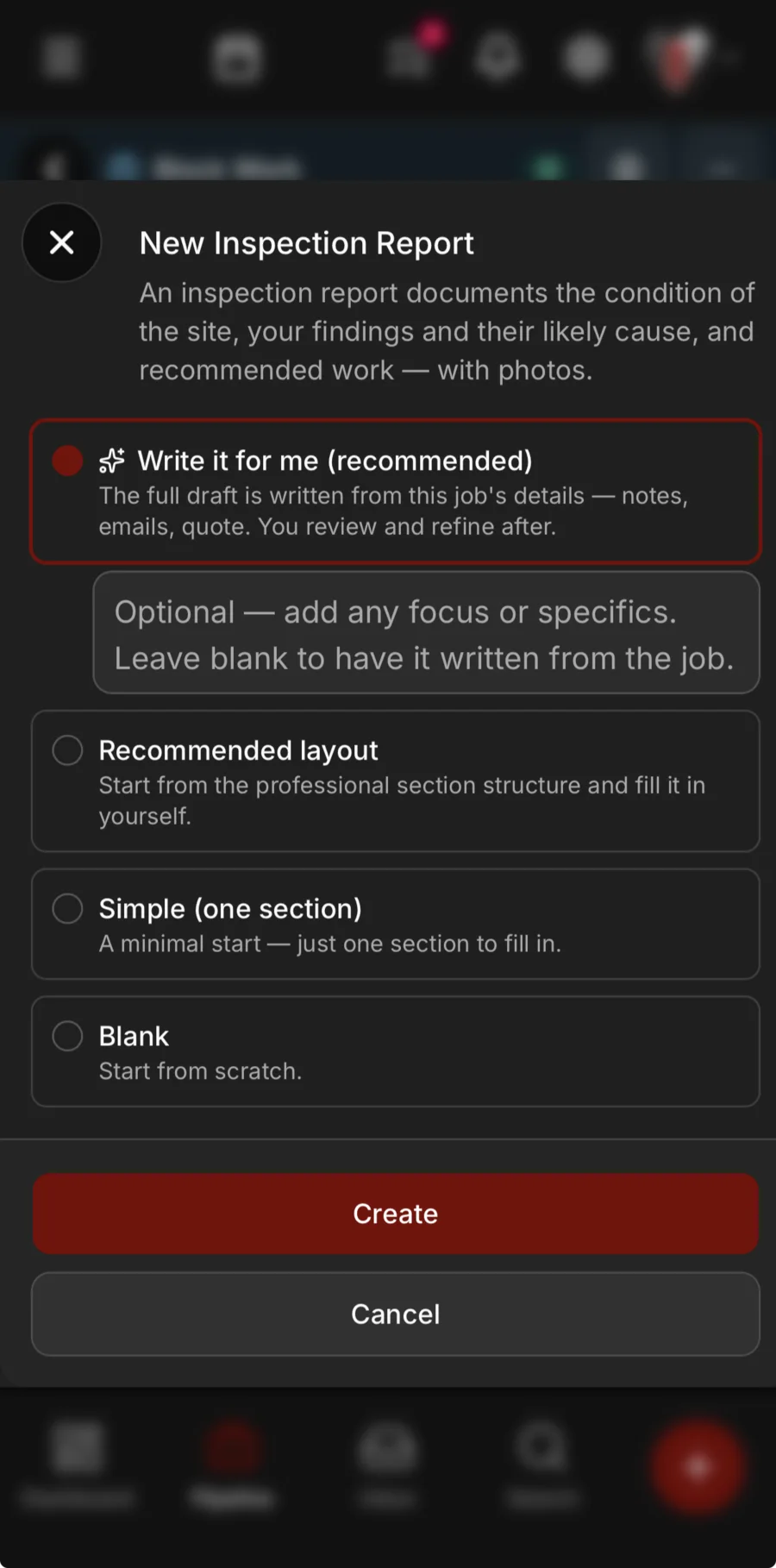
  • New Inspection Report: Write it for me, recommended — the full draft written from the job’s notes, emails and quote — with a box for any focus, or Recommended layout, Simple (one section) or Blank, then Create.

    Write it for me. The whole draft from the job’s notes, emails and quote — or start from a layout, one section or a blank page. Trades

  • An inspection report as its PDF: the observations and the recommended repairs to a block building, then Photo Documentation — two photos of the building, captioned Photo 1 and Photo 2.

    With the job’s photos. Pick them yourself, or let Daybook choose the ones that back up your findings and caption them. Trades

  • Work plan, inspection report, O&M manual, warranty, closeout package
  • Drafted from the job’s notes, messages and quote — never its prices
  • Your policies and spec sheets from your company files, read in
  • Photos picked and captioned for you, or pick your own
  • Nothing is saved or sent until you say so
Paperwork

The books

The books keep up with the work.

Invoices raised off what was agreed, and chased with a Pay Now link until they’re paid — e-transfers matched for you to confirm, cards online. Then more than twenty reports built from the work itself, and every pay period’s hours added up.
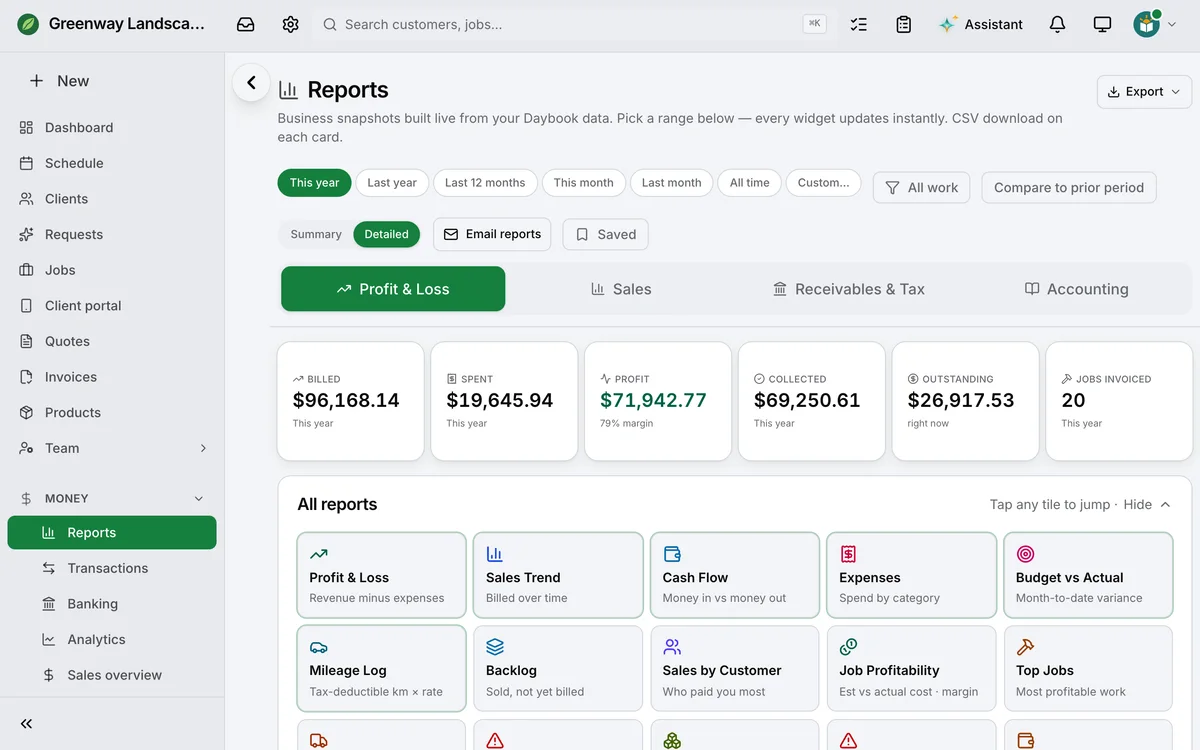
The year at a glance

Billed, spent, profit, collected and still owed — then more than twenty reports, from Profit & Loss to Sales Tax.

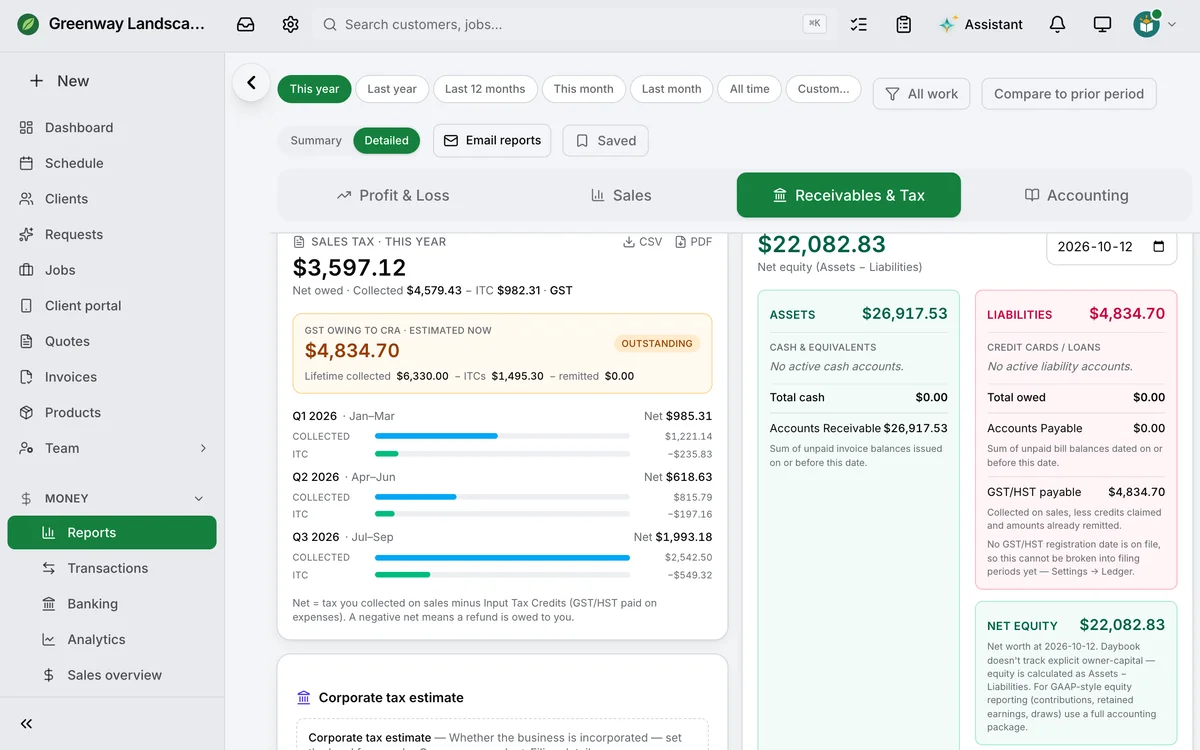
Sales tax, worked out

What you collected, less the GST/HST you paid on expenses — and an estimate of what you owe CRA, quarter by quarter.

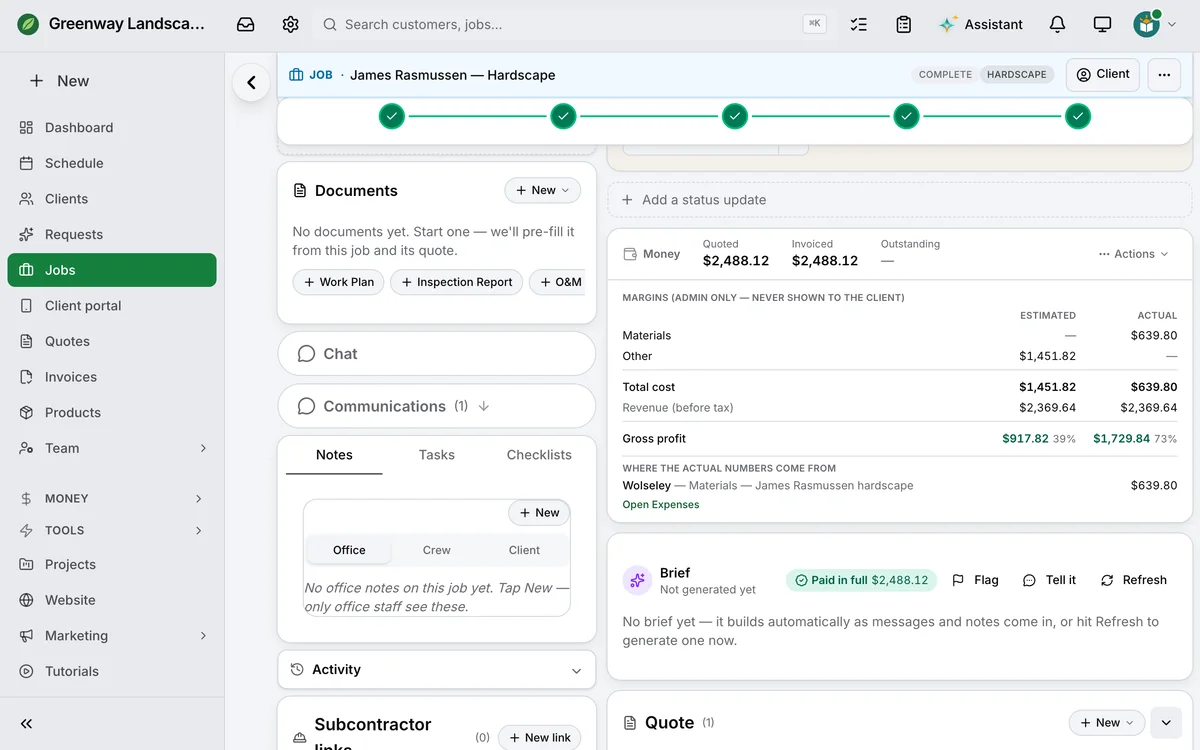
Margins, job by job Trades

Estimated from the quote against actual — the materials and expenses tagged to the job and the hours clocked at each person’s wage.

Paid

The invoice shows what came in, with the receipt and a review request one tap away.

Paid from the invoice

Where you take cards, your client pays from their own page — in full or a portion, without a call to the office.

Or on site Trades

With a card reader, the crew charges the invoice for the job they’re on — tap, insert or Interac debit.

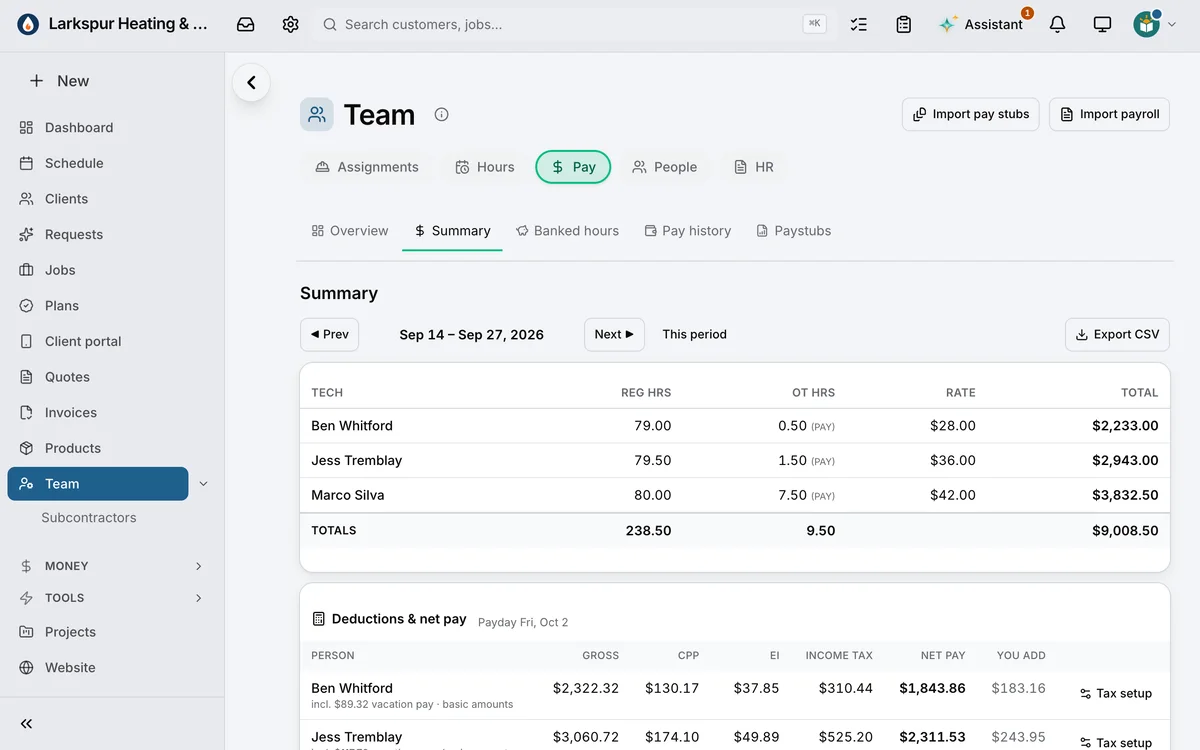
Every pay period, added up

Each person’s regular and overtime hours at their rate, with overtime worked out by your rule.

The reports page in Daybook, the year’s figures first: Billed, Spent, Profit, Collected, Outstanding and Jobs invoiced, and the list of every report.
The Sales Tax report: what was collected, less the tax paid on expenses, by quarter: GST owing to CRA, Jan–Mar $985.31, Apr–Jun $618.63 and Jul–Sep $1,993.18.
A job’s margins, estimated against actual: Total cost $1,451.82, Revenue (before tax) $2,369.64 and Gross profit.
An invoice paid in full, in Daybook: INV-0103, paid, $5,670.00.
A client’s own invoice on their page: INV-0098, $5,071.50 owing and down to “Pay $5,071.50”.
Quote & bill in the crew app, Marco on the repointing job: Invoice INV-0098 for $5,071.50, with Take payment, Charge on the reader, Send the pay link and Cash or cheque.
The last pay period’s run: Ben Whitford, Jess Tremblay and Marco Silva, regular and overtime hours, each person’s rate and pay, and Export CSV.

The books

The books keep up with the work.

Invoices raised off what was agreed, and chased with a Pay Now link until they’re paid — e-transfers matched for you to confirm, cards online. Then more than twenty reports built from the work itself, and every pay period’s hours added up.
  • Invoices raised off what was agreed — nothing re-typed
  • An overdue invoice chases itself, with a Pay Now link
  • E-transfer matched for you to confirm; cards online; EFT
  • Profit & Loss, Cash Flow, A/R Aging, Sales Tax and the Filing Calendar, built from the work itself
  • Upload a bank statement: every line sorted and categorised for you to check
  • Each person’s CPP, EI and tax worked out for every pay, outside Quebec — the numbers; you pay and remit
Invoicing & payments

Toronto

is where your database lives — Canadian-hosted, encrypted in transit and at rest, every business its own account.

$0

per field seat on Crew and Company. Coaches, counsellors and maintenance crews are free on every club, camp and property plan.

GST · HST

by province, on every invoice and in the Sales Tax report — built into the ledger, not bolted on.

Built inside a working masonry company in Calgary — crews in the field every working day — and run from Prince Edward Island.

Same app, your words

One workflow. Two kinds of day.

The mechanics are the same whoever you are. What changes is the vocabulary — and the tools that are switched on.

Workflow Field & service trades Facility & care
Winning the work Quotes built from your own labour, materials and markups — the same answer every time — and signed in the client’s portal. Registration by term, by week or by day, waitlists, and families who register once and come back every season.
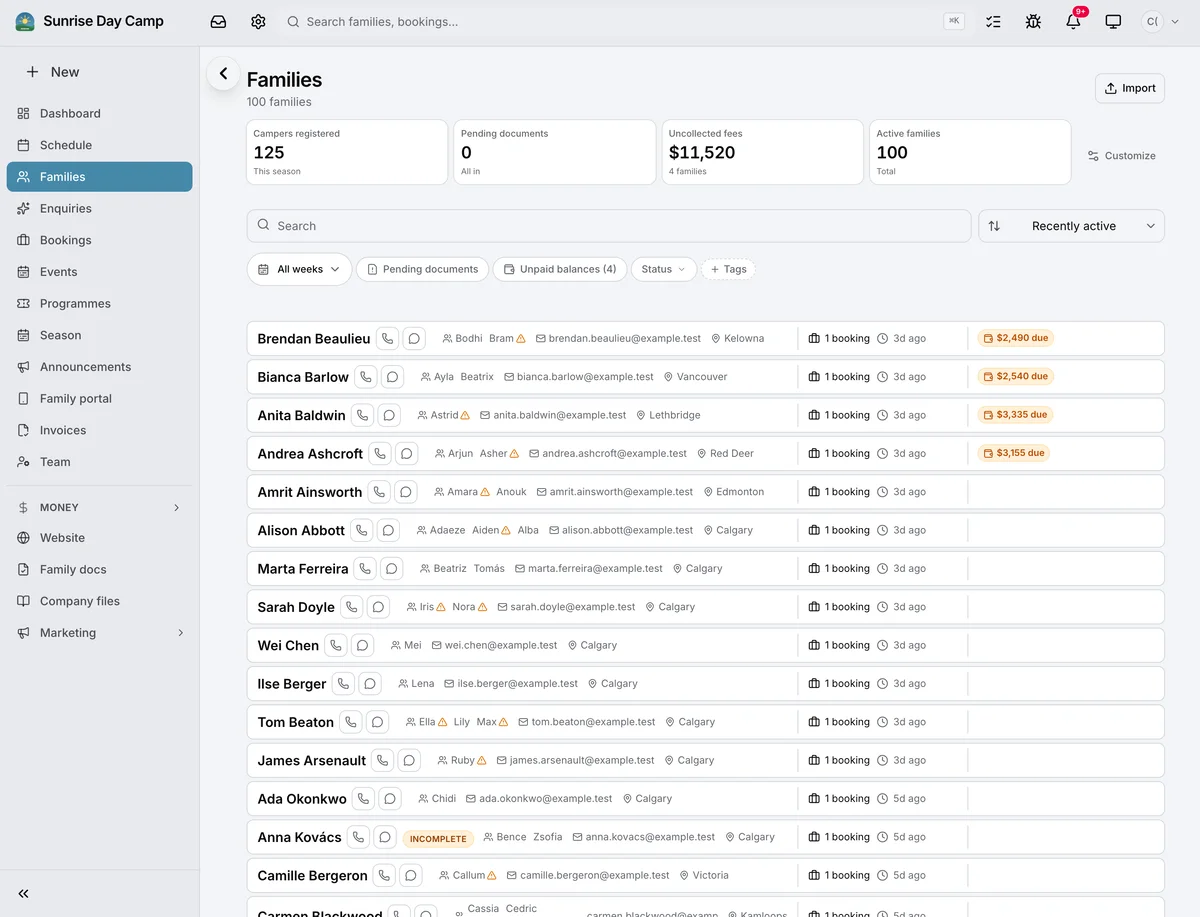
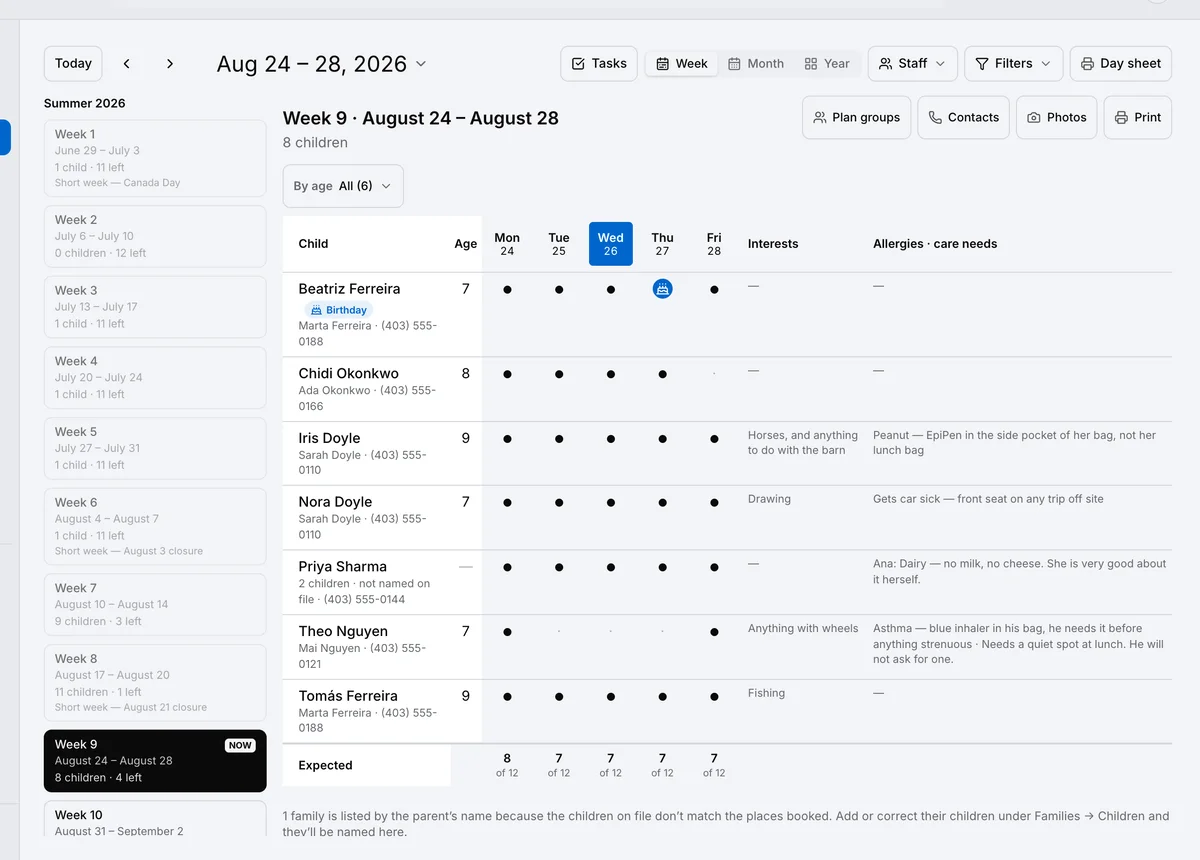
The day Clock-in, FLHA safety forms, checklists and photos from the site — offline too. The week board: every child, the five days across, allergies and medications beside them. Waivers signed before the first day.
The client A client hub: quote approvals and revisions, invoices, a way to pay and a way to message you back. A family portal: what they booked, what they owe, photos and consents, the schedule — and a way to pay or ask.
The money Progress invoicing on long jobs, GST/HST by province, e-transfers matched for you to confirm. Monthly billing for a centre or a club, a deposit at registration for a camp; cards and e-transfer; every payment on the family’s record.

How it’s charged

Growing shouldn’t cost you a seat.

Most software in this market charges by the head. Daybook charges the office and leaves the people doing the work alone.

Workflow Field-service platforms priced per user Care platforms priced per child or per room Daybook
Currency Often billed in US dollars — the exchange rate and your card’s foreign fee ride along. Often billed in US dollars, with the modules priced separately. Canadian dollars. Every plan, every add-on, printed on the pricing page.
The people doing the work Typically an extra monthly fee for every field user past the plan’s cap. Typically an extra fee per staff login, per classroom or per child. Field seats free and unlimited on Crew and Company. Coaches, counsellors and maintenance crews free on every club, camp and property plan. Daycare plans include their staff seats.
Your website Usually a separate builder, or a designer. Usually not provided. Included on every plan — a trade, a rep agency, a club, a camp or a daycare starts from pages written for its work; live when you press Publish.
Canadian tax Usually an accounting add-on. Usually worked out by hand. GST/HST by province on every invoice, and the Sales Tax report ready for filing.

Six rate cards — one per kind of business — all on the pricing page. Nothing here is a discount, and there is no setup fee.

Built for Canadian books.

The four things a Canadian business does every week that the rest of the market treats as an add-on.

Receipts

A receipt read down to the line

Snap it. It fills itself in, and you check it before it saves.

Mileage

A mileage log that keeps itself

Log the trip at your own per-kilometre rate — ready for the accountant.

Sales tax

GST/HST by province

The right rate on every invoice, and the Sales Tax report ready for filing season.

Interac

E-transfers matched to the invoice

Read from the notice, matched for you, confirmed by you before it books.

Questions, answered.

Is Daybook only for trades?

No. It runs field and service trades and facility and care businesses — camps, clubs and property management among them — each in its own words. Say what you run when you sign up, and the menus, the buttons and the paperwork follow; the tools you do not need are switched off, not hidden.

Do I pay for every person on my team?

No. Daybook charges the office and leaves the people doing the work alone.

Trades and field service: field seats are free and unlimited on Crew and Company.

Property management: maintenance crews are free and unlimited on every plan.

Gymnastics and rec clubs: coaches and instructors are free and unlimited on every plan.

Day camps: seasonal counsellors are free and unlimited on every plan.

What does it cost?

Every plan and every add-on is printed on the pricing page, in Canadian dollars. There is no setup fee, and you can read every figure without speaking to anyone.

Where is my data kept?

Your database is in Toronto: Canadian-hosted, encrypted in transit and at rest, and every business is its own account.

Can I bring my clients with me?

Yes. Bring your client list as a spreadsheet, or paste it in. It is your list that comes across — not an importer for another product’s export.

Does the brief send messages to my clients?

No. The brief reads what is on the job and drafts the reply or the booking for you. You read it, and you send it. The brief and the Assistant says what it reads and what it does by itself.

Ryan seated in the hearth of a brick fireplace he built — his Red Seal final exam.
The Red Seal final exam — a fireplace, built by hand.

Where it came from

Built in the field. Engineered on the Island.

Ryan studied computer engineering in Toronto, then apprenticed as a bricklayer, earned his Red Seal, and in 2014 started a masonry company in Calgary that still has crews in the field every working day. When he moved home to Prince Edward Island he ran his half of it from five thousand kilometres away — the quotes, the schedule, the money, the email — and nothing off the shelf would show him the whole business in one place. Daybook is what that distance taught him to build.

The office sees everything. The field never has to stop.

— Ryan, founder

Read the whole story

Take complete control of your business today.

Start the trial, bring a real week of work, and watch it run in Daybook — your schedule, your conversations, your paperwork, your money.

14-day trial · No credit card · Bring your client list